How to Choose the Best SMP Clinic in the UK

Guide on choosing the best SMP clinic in the UK

Choosing the best SMP clinic in the UK comes down to something the flashiest websites rarely prove, which is the skill of the person holding the needle. Scalp micropigmentation places thousands of tiny pigment dots across your scalp and they stay there for years, so the artist’s judgement decides whether you get a natural hairline or work you will pay to fix. 

The good news is that quality leaves clues. Credentials, healed photos, honest reviews and an unhurried consultation tell you far more than a homepage calling itself number one. This guide walks through what to check, the red flags worth walking away from, the questions to ask, and what good work should cost.

Key Takeaways

  • The best SMP clinic in the UK is the one with the right skills for your hair loss, not the closest address or the cheapest quote.
  • Look for specialist SMP training backed by trichology knowledge, not a general tattoo licence.
  • Ask to see healed photos from six to twelve months on, since fresh work always looks darker and sharper than the final result.
  • Read independent reviews, and treat a free, unhurried consultation as your real test of a clinic.
  • Walk away from cut-price offers, a missing portfolio, pressure tactics, or promises of perfect results.
  • A full head usually costs around £2,000 to £3,500, more in central London, and much cheaper full coverage is a warning sign.

What Makes a Great SMP Clinic Stand Out?

A great SMP clinic stands out on a few checks you can verify yourself, long before you book. Skill and honesty show up in credentials, results, reviews and how the consultation is run.

Qualifications and training

The first check is training built for SMP, not borrowed from tattooing. A tattoo licence shows someone can ink skin, but it says nothing about replicating hair follicles at the correct depth or matching shades across different skin tones.

Look for dedicated SMP certification, and treat trichology knowledge as a real bonus. A practitioner who understands scalp conditions and hair loss patterns knows when SMP suits you and when to send you for medical advice first.

Experience with your type of hair loss

Skill is specific. A portfolio full of small hairline tidy-ups tells you little about advanced baldness, dense scar tissue or diffuse thinning in women, so the experience has to match your case.

Ask how many clients with your pattern and skin tone the artist has treated. Years of steady practice count too, since the regular cases are where an artist learns to avoid pigment blowouts on thin skin and to keep tones right as work heals. 

Healed photos, not just fresh work

Fresh SMP always looks darker and sharper than it will a year on, so a wall of day-of photos can hide how the work really settles. Ask to see healed photos taken six to twelve months after the final session.

Healed results show the truth, the real colour, the spacing between dots, and whether the hairline still reads as natural once it has faded slightly. Ask for unedited shots in natural light from several angles, including the unflattering overhead one.

Close-up of realistic scalp micropigmentation.

Reviews and references

Independent reviews carry more weight than anything on a clinic’s own page. Google, Trustpilot and the hair loss forums show patterns that polished testimonials gloss over.

Watch for consistent praise about specific qualities, and for repeat complaints about fading or slow replies. It is also fair to ask for references from past clients with a similar pattern to yours. A confident clinic shares them without fuss.

The consultation

A free, unhurried consultation is the clearest window into any clinic. It shows whether the practitioner assesses you or just sells to you.

A good one includes a proper scalp examination under decent light, a look at your hair loss pattern, and questions about your medical history, medications and lifestyle. The practitioner should be honest about limits, since SMP creates no real hair and suits some styles better than others. A video consultation is a useful way to shortlist clinics before you commit to travelling in.

Get a free, no obligation consultation

Click below to book your free consultation today, and take the first step toward a stronger, fresher, happier you.

Red Flags to Watch Out For

Some warning signs are worth acting on straight away, whatever the price or the convenience. If you spot any of these, keep looking.

  • Suspiciously cheap quotes. Full-head coverage under roughly £600 to £800 usually points to rushed sessions, cheap pigment or an inexperienced artist, and correcting it costs more than quality work would have.
  • No healed portfolio. A clinic that shows only fresh, day-of photos, or cannot produce healed images from six to twelve months on, is hiding how its work ages.
  • A rushed or skipped consultation. Under twenty minutes, no scalp examination, and no questions about your history signals volume over care.
  • Guaranteed perfect results. No honest artist promises perfection for everyone. Skin type, healing and head shape all affect the outcome, and SMP grows no real hair.
  • Pressure to book today. “This price ends tonight” or “one slot left” is a sales line, not a clinical reason. A good clinic holds its pricing and lets you think.
  • Missing credentials or hygiene. If they cannot show SMP certification and insurance, or you see anything other than sealed, single-use needles and a clean room, leave.
  • Defensive answers. An artist who bristles at straightforward questions about pigment, needles or aftercare is telling you something. Skilled ones answer plainly.

Questions to Ask Before You Book

A consultation is your chance to test a clinic, not just be sold to. Take these with you, and listen for specific answers, not reassurance.

  • “How many cases like mine have you treated?” Expect a real number and healed photos of clients with your pattern and skin tone, not a vague “plenty.”
  • “Will you do the work, or will someone else?” At clinics with several technicians, confirm who actually treats you and check their results, not just the founder’s.
  • “What pigment do you use, and how will it age?” A good answer names the pigment and explains how the shade softens over the years, rather than “professional grade.”
  • “How many sessions will I need, and what is the total cost?” You want a clear session count and one all-in figure, not a low “from” price that climbs later.
  • “What is your touch-up policy?” Look for at least one included refinement within six to twelve months, written into your agreement.
  • “What is the aftercare, and what will I need to avoid?” Expect specific timelines, such as no sweating for around four days and no heavy exercise for about a month.
  • “What can SMP not do for me?” An honest run-through of your limits shows the artist is assessing you, not closing a sale.

Does Location Matter, and Is It Worth Travelling for SMP?

Location matters less than you would think. SMP is a short course of two or three sessions, not a weekly commitment, so the artist’s skill should outrank the postcode every time.

If you are searching for a hair tattoo clinic in London, you have the widest choice in the country, since most of the UK’s experienced artists work in and around the capital. From Manchester, Birmingham, Glasgow or Edinburgh, specialist SMP options are thinner on the ground, which is why many people either travel for the right artist or start with a video consultation.

A video consultation does a lot of the work before you commit to a trip.

  • It can assess your hair loss from clear photos, talk through whether SMP suits you, give a rough plan and quote, and show you how the artist communicates.
  • It cannot replace the close-up scalp assessment, shade-matching and hairline mapping that have to happen in person on the day.

If you do travel, plan for the return trips, since the sessions sit a week or two apart. There is also a premium route that turns the problem around. With ScalpNation’s VIP service, Will travels to you, with the logistics arranged so you are treated at a location of your choice, in the UK or abroad.

Natural hairline restoration using SMP technique.

How Much Should a Good SMP Clinic Charge?

A good SMP clinic in the UK usually charges around £2,000 to £3,500 for a full head, spread across all the sessions, with central London at the higher end.

TreatmentTypical UK price (all sessions)
Full-head coverage£2,000 – £3,500
Hairline or crown only£500 – £1,000
Scar camouflage£900 – £1,850
Density for thinning hair£2,000 – £2,850

A few points to keep in mind. The figure should cover the whole job, the design and mapping, every session, the pigment and aftercare, so be wary of a low “from” price that grows once you are booked. Central London sits at the top of these ranges, sometimes near £4,000 for a full head. And full coverage priced well under £600 to £800 is the warning sign covered earlier, not a bargain.

Most work also needs a light touch-up every few years to keep it sharp, which is a smaller cost worth planning for. Good clinics are upfront about payment too, usually a small booking fee that comes off the total, with the balance split across your first sessions.

ScalpNation publishes its own ranges on its costs page, and most cases land between roughly £2,150 and £2,850.

Book Your Consultation with Will Quaye 

Run any clinic you are considering through the checks in this guide, and apply the same scrutiny to ScalpNation. Will Quaye is a three-time award-winning SMP artist and a qualified clinical trichologist, with more than six years of work and clients from over twenty countries, so the skill, the credentials and the healed results are all there to inspect.

You can judge for yourself before committing to anything. The first consultation is freeand carries no obligation, in person at the Essex clinic or by video call, wherever you are in the country, and you can see real, healed client results on the testimonials page. When you have done your homework, book your consultation.

FAQ

Two or three is a sensible number. Most consultations are free, so comparing a few costs you only time, and it quickly shows which clinics assess you properly and which push a quick booking.

For a first assessment, yes. A video call can judge suitability, rough cost and how the artist communicates. The treatment itself, and the close-up scalp mapping and shade-matching it needs, still has to be done in person.

Rarely. Full-head coverage priced well under £600 to £800 usually means cut corners on pigment, training or session time, and poor work is expensive to undo. Paying for skill once costs less than paying to fix a bargain later.

Good SMP holds for several years, then fades gradually to a lighter version of itself. Most people refresh it every few years to keep the definition sharp. It does not vanish unless you have it lasered off.

A reputable clinic includes a touch-up window for genuine concerns. For seriously poor work, laser can lighten or remove the pigment before it is redone, though that costs more than getting it right the first time. This is why the initial choice carries so much weight.

What to Know About SMP vs Hair Systems

SMP vs hair systems graphic

Hair loss pushes most people toward one of two non-surgical solutions: a hair system or scalp micropigmentation. Both conceal the same problem. Neither is universally better. 

The right choice depends on how you live, what stage your hair loss has reached, what your budget looks like over time, and whether you’re ready for something permanent. So, in this article, we’ll lay out both options honestly, so you can decide for yourself.

Key Takeaways

  • Hair systems and SMP solve the same problem in completely different ways — one is wearable and removable, the other is a permanent change to the scalp itself.
  • Hair systems offer styling flexibility and reversibility; SMP offers consistency, zero daily upkeep, and long-term cost efficiency.
  • Neither option is objectively better — lifestyle, loss stage, budget, and readiness for permanence all shape the right answer.
  • Five specific scenarios favour a hair system, including the desire for length, removability, and mild climates with low physical demand.
  • Five specific scenarios favour SMP, including active lifestyles, advanced hair loss, scar camouflage, and long-term cost of ownership.
  • A hybrid approach exists — and most people are never told about it.
  • The comparison applies to women, too, though female hair loss patterns shift how each solution performs in practice.
  • A free consultation is available if you want an honest assessment of which option suits your specific situation.

What Is a Hair System?

A hair system for men (and for women) is a custom-made unit of real or synthetic hair, attached directly to the scalp using adhesive tape, glue, or clips. Think of it as a precision-fitted, wearable solution that sits on top of the scalp rather than altering it. Quality units can be cut, coloured, and styled like natural hair, including worn at length.

Hair systems come in several base types:

  • Lace front — lightweight and breathable, with a natural-looking hairline.
  • Skin base — thin polyurethane that bonds closely to the scalp.
  • Monofilament — durable mid-range option with good ventilation.

The defining characteristic of any hair system is that it requires ongoing commitment. Units need reattaching every one to two weeks and replacing every three to six months. Adhesives, specialist cleaners, and colour matching are all part of the routine.

Day one in a quality system can look impressive, but what follows is a long-term relationship with maintenance that catches many people off guard. 

What Is Scalp Micropigmentation?

Scalp micropigmentation is a non-surgical cosmetic procedure that deposits tiny dots of pigment into the upper layers of the scalp, replicating the look of closely cropped hair follicles. No hair grows. The result is a precise, consistent visual impression of a shaved or buzz-cut head.

Most clients complete three sessions spaced roughly two weeks apart. Each session builds on the last, gradually increasing density and refining the hairline. Results are visible almost immediately after the first appointment.

The pigment is long-lasting but not indefinite. Natural fading develops over several years, at which point a single touch-up session restores the appearance. It won’t vanish on its own without laser removal.

SMP works best when the head is kept closely shaved. The pigmented dots and natural stubble blend together to create the effect. Worn at length, that illusion breaks down.

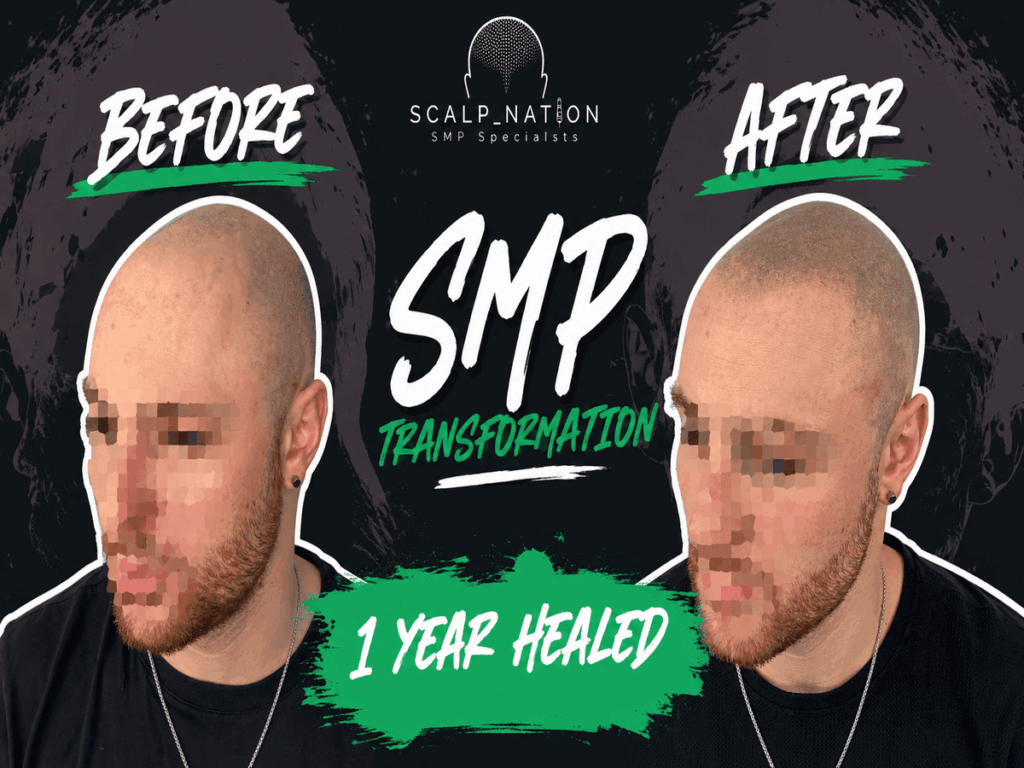
1 year healed SMP result

SMP vs Hair Systems: Side-by-Side

On paper, both options address hair loss. In practice, they ask completely different things from you — different budgets, different routines, different lifestyles, and different levels of commitment. So, we created a table below that covers the factors that tend to drive the final decision.

FactorHair SystemSMP
Hair lengthAny length or styleShaved/buzz-cut for full baldness (existing hair of any length for density work)
Daily upkeepHigh — adhesives, cleaning, stylingMinimal — regular shaving only
Reattachment frequencyEvery 1–2 weeksNot applicable
Unit or touch-up lifespanUnit replaced every 3–6 monthsTouch-up every 3–5 years
Water and sweat resistanceAdhesive weakens with moisture and heatFully resistant once healed
Upfront cost (UK)£300–£1,500+ per unit£2,450–£3,000 typical
Estimated 5-year total cost£3,000–£6,000+£2,450–£3,500 incl. one touch-up
Appearance day to dayCan vary with wear, humidity, and colour fadeIdentical every single day
Scar coverageSits above the scalp, does not blend scar tissueSpecialist technique blends directly into the scalp
ReversibilityFully reversible — stop at any pointRequires laser removal to reverse
Suitable for womenYes — wigs, integration systems, full unitsYes
Pain or recoveryNoneMild redness for 24–72 hours per session
Sun sensitivityLowUV exposure accelerates fading — sunscreen recommended
Activity restrictionsAvoid prolonged water exposure and heavy sweatingAvoid sweating for 4 days (after procedure), swimming for 28 days post-session. After that, everything is allowed. 

When Is a Hair System the Better Choice?

1. You want to wear your hair at length

SMP works with existing hair to add density, but on a fully bald scalp, the effect only reads convincingly at very short lengths. If your goal is styled, longer hair — a fringe, a parting, a cut you can run your hands through — a hair system is the only non-surgical route that delivers it. For many people, this single factor settles the decision entirely.

2. You’re not ready for a permanent commitment

A hair system asks nothing permanent of you. Stop wearing it, and nothing has changed. SMP fades gradually but doesn’t disappear without laser removal. If you’re still working through the emotional side of hair loss and want to keep your options fully open, a system gives you that breathing room.

3. You have a medical contraindication for SMP

Certain scalp conditions, a history of keloid scarring, or active skin disorders can make SMP inadvisable. A qualified trichologist can assess this during a consultation, but it’s worth knowing in advance that SMP isn’t appropriate for every scalp.

4. Your climate and lifestyle are adhesive-friendly

Adhesive performance suffers in sustained heat and humidity. If your daily life is largely office-based, your climate is mild, and intense physical activity is occasional rather than routine, the practical gap between a system and SMP narrows considerably.

5. You need the option to remove it

Some people want a solution they can take off — for privacy, intimacy, or personal preference. A hair system comes off when you choose. SMP does not. For anyone who values that control, a system has an advantage no other non-surgical option can replicate.

When Is SMP the Better Choice?

Five situations where SMP consistently outperforms a hair system. 

1. Daily maintenance has worn you down

Long-term hair system wearers often describe a slow shift in how the system feels. What started as relief gradually becomes a schedule — reattachment appointments, adhesive application, colour matching as natural hair greys. SMP removes that cycle entirely. Once healed, there is no routine beyond shaving.

2. Your lifestyle involves sport, swimming, or physical work

Sweat and prolonged water exposure degrade adhesive bonds. For competitive swimmers, regular gym-goers, manual workers, or anyone whose daily life doesn’t pause for maintenance windows, SMP is structurally more practical. It doesn’t lift, shift, or react to saltwater. After the initial healing period, there are no activity restrictions at all.

3. Your hair loss is at Norwood 5, 6, or 7

At advanced stages, the area needing coverage expands significantly. Understanding where you sit on the Norwood scale puts that into context. Higher classifications mean a hair system must cover most of the scalp, which increases cost, complexity, and the frequency of reattachment. SMP scales to any level of loss without those compounding demands.

4. You have transplant or injury scars to camouflage

SMP deposits pigment directly into scar tissue, blending it with the surrounding scalp. A hair system sits above the scalp and does nothing to address scarring underneath. For anyone with FUT strip scars, FUE puncture scars, or injury-related scarring, SMP offers scar camouflage, a targeted solution that no hairpiece can replicate. 

5. The 10-year cost of ownership is a deciding factor

The upfront cost of SMP is higher than a single unit. Over a decade, the picture shifts. Unit replacements, adhesives, specialist products, and reattachment appointments can reach two to four times the lifetime cost of SMP with one touch-up included. For anyone thinking long-term, the numbers favour SMP clearly.

Natural scalp micropigmentation result

Can You Actually Use Both?

Few people know this is an option. Fewer still realise how practical it can be.

SMP and hair systems are not mutually exclusive. 

Some clients choose to have SMP completed first, then continue wearing a hair system over it during the adjustment period. The SMP provides a natural-looking base for moments when the system comes off — swimming, intimacy, or simply testing life without it. It removes the all-or-nothing pressure that puts many people off SMP in the first place.

A second approach works differently. Some people maintain a hair system for specific occasions where length or styling is preferred, while using SMP as their everyday baseline. The result is flexibility without vulnerability — a consistent, presentable appearance regardless of whether the system is worn that day.

What to consider before going hybrid

  • Pigment shade needs to be matched carefully to the hair system colour.
  • A practitioner who understands both solutions will give more accurate guidance than one who specialises in only one.
  • The approach works best when planned from the start rather than added as an afterthought.

This combination rarely appears in standard consultations. If it sounds relevant to your situation, it is worth raising directly when you speak to a specialist.

Does This Apply Differently for Women?

The core comparison holds, but the context shifts. Female hair loss more commonly presents as diffuse thinning across the scalp rather than a receding hairline, which changes how each solution performs.

Hair systems for women range from full wigs to partial integration units that blend with existing hair. They offer styling flexibility and immediate coverage, particularly useful when loss is sudden or uneven.

SMP for women typically focuses on density enhancement rather than the full shaved-head aesthetic seen in male treatments. It works well for widening parts, thinning crowns, and hairline definition — areas where a hair system can feel excessive relative to the problem.

The same five scenarios from both earlier sections apply. The question is still about lifestyle, loss pattern, and how much daily involvement feels acceptable.

Still Unsure Which Direction to Take?

Both options have genuine merit. The right one depends on details that are difficult to assess without looking at your specific scalp, hair loss pattern, and lifestyle. 

At Scalp Nation, free consultations are available in person or via video call. If a hair system suits your situation better, that is what we will tell you. Book a free consultation and get an honest answer.

FAQ

Yes. Pigment placed too deep, too dark, or with poor hairline design can produce an unconvincing result. Choosing a qualified, experienced practitioner is the single most important decision in the process.

Prolonged adhesive use can cause irritation and sensitivity. Regular scalp care and choosing gentler attachment methods reduce the risk considerably.

Yes. SMP works well alongside existing hair to add the appearance of density. You do not need to be fully bald for the treatment to be effective.

A trichologist or trained SMP practitioner can assess this during a consultation. The Norwood scale is also a useful reference for understanding where your hair loss currently sits.

Yes. For diffuse thinning, widening parts, or hairline definition, SMP can be highly effective without requiring a shaved head.

SMP for Hair Transplant Scar Camouflage 

SMP for hair transplant scar camouflage

If you’re reading this, the transplant probably didn’t turn out the way you expected. Maybe the donor area looks patchy, or a scar is now showing where the surgeon said it wouldn’t. That experience is far more common than most clinics admit. 

Hair transplant scar camouflage using scalp micropigmentation (SMP) has become one of the most reliable non-surgical solutions — covering both FUE and FUT outcomes, without another procedure, another recovery, or another round of crossed fingers.

Key Takeaways

  • FUE and FUT procedures leave distinctly different types of scars — and this affects how SMP is applied.
  • SMP doesn’t erase a scar. It camouflages it — and a well-executed treatment can reduce visibility dramatically.
  • FUE scar cases typically require 2–3 sessions; FUT strip scars are more involved and usually call for 3–4.
  • There are situations where SMP won’t deliver good results — active donor-area loss, keloid scars, and extensive necrosis among them.
  • The practitioner you choose matters more for scar work than for almost any other SMP application.

What Scars Does a Hair Transplant Leave?

Two procedures, two very different types of scarring — and knowing which one you’re dealing with directly shapes how scar camouflage after hair transplant is approached.

FUE and FUT both leave marks. The difference lies in their shape, location, and how each responds to treatment.

FUE ScarsFUT Scars
ShapeSmall, circular punch marksSingle horizontal linear strip
LocationScattered across the donor area (back and sides)Lower back of the scalp
VisibilityClear at shaved, or very short lengthsVaries — can widen, raise, or discolour
SMP approachModerate complexity — flat dots blend readilyHigher complexity — raised or wider tissue

FUE is frequently marketed as the “scarless” option. That framing doesn’t hold up under a close look. Depending on how many grafts were removed and how aggressively the donor zone was treated, you can end up with dozens to hundreds of pale, circular dots running from ear to ear. At a grade one or two, they show clearly. Growing hair longer masks them at certain lengths, but that’s not a solution for anyone wanting to keep their hair short.

FUT leaves a single strip scar along the lower back of the scalp. Less widespread, but not necessarily easier to live with. Width and visibility depend on surgical technique and individual healing — some remain fine and flat, others raise or widen noticeably over time.

Both types are strong candidates for SMP for hair transplant scar work. The approach just looks different for each.

Identified your scar type? Get a free expert assessment

Will Quaye reviews both FUE and FUT scar cases — in-person or via photos. He’ll tell you straight whether your case is a strong fit and how many sessions to expect.

How Does SMP Camouflage Scars After a Hair Transplant?

Scalp micropigmentation deposits tiny dots of pigment into the upper layer of the scalp skin, each one replicating the look of a shaved hair follicle. On a healthy scalp, this creates the illusion of density or a closely cropped head. On scar tissue, the same logic applies, but the technique requires more care and more sessions to achieve a clean result.

Why Scar Tissue Responds Differently

Healthy scalp skin holds pigment in a predictable way. Scar tissue doesn’t. The structure of a healed scar is denser, less elastic, and often uneven in colour compared to the skin around it. Pigment absorbs inconsistently, which means a single session rarely produces the result you’re aiming for.

Layering is the answer. A skilled practitioner builds pigment gradually across multiple sessions, letting each layer settle before adding more. This layered process allows for precise colour matching and avoids the flat, oversaturated look that can come from rushing the work.

What “Camouflage” Means in Practice

SMP reduces the contrast between the scar and the surrounding scalp. It doesn’t remove the scar itself. A well-executed scar camouflage after hair transplant treatment typically achieves a 70-85% reduction in visual contrast. 

For most clients, that shift is enough to change how they carry themselves. No more angling away from cameras. No more calculating where to sit in a room. Hair transplant scar camouflage done well removes the quiet mental weight that came with it.

What Can FUE Patients Realistically Expect from Scar Camouflage?

FUE dot scars respond well to SMP. They’re flat, relatively contained in size, and their scattered distribution works in the practitioner’s favour. Pigment deposits placed between and across the circular marks blend naturally into the surrounding follicle pattern. Of the two transplant scar types, FUE cases tend to produce the most consistent outcomes.

How Many Sessions Does FUE Scar Work Require?

Most FUE scar camouflage cases are completed across two to three sessions, spaced roughly two weeks apart. The first session lays down the base tone across the donor area. The second builds density and refines the colour blend. A third session, if needed, covers any areas where pigment retention was uneven.

Cases involving heavier over-harvesting may need all three sessions to achieve a uniform result, since there’s more surface to cover and the dot scars tend to cluster more densely across the donor zone.

When Should You Start?

Timing here is really important. Starting too early risks inconsistent pigment retention, since the scalp tissue hasn’t fully stabilised after surgery. Most practitioners recommend waiting at least six to twelve months post-transplant before booking your first FUE scar cover-up session. The donor area should be fully healed and any ongoing hair loss settled before work begins.

What Length Works Best?

The cleanest results come at a grade one or grade two. At those lengths, the dot scars are clearly visible without treatment but largely undetectable once pigment has been applied evenly. At longer lengths, existing hair already masks much of the scarring, making scar camouflage after hair transplant less pressing.

You can see what realistic outcomes look like in our before and after results.

What Should FUT Patients Know About Strip Scar Camouflage?

FUT strip scars respond to SMP, but they require a more gradual process. The linear scar across the lower back of the scalp presents different challenges from scattered dot scars, and that affects both the number of sessions needed and what the final result will look like.

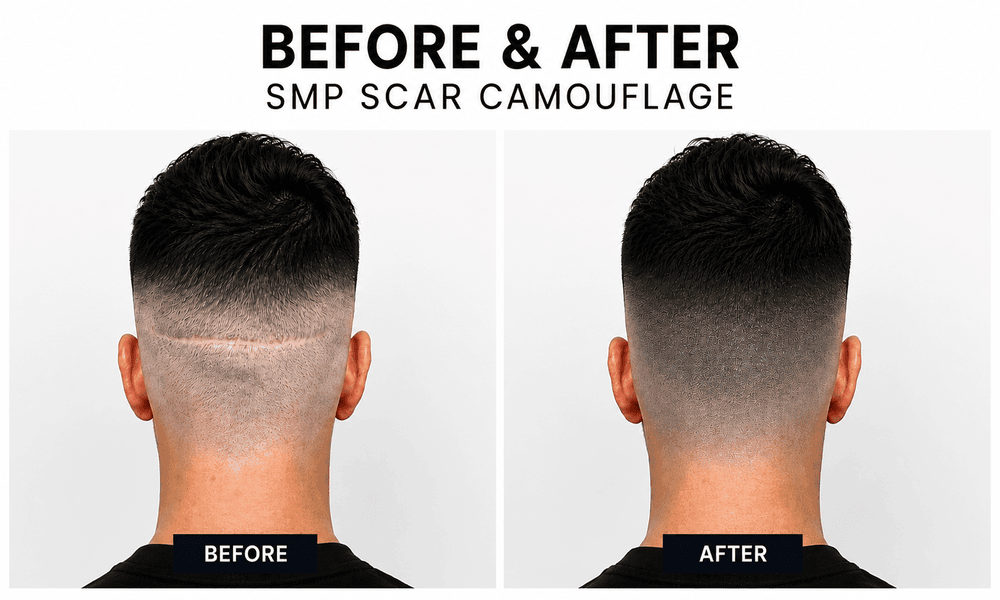
Before and after SMP scar camouflage results

Why the Strip Scar Is a More Demanding Case

A linear scar is typically wider than individual FUE extraction points, and its surface is rarely uniform. Some sections will be flat and healed cleanly. Others may be slightly raised or have a different texture to the surrounding skin. Pigment behaves differently across these variations, which is why building the result gradually matters even more here than in FUE cases.

How Many Sessions Does FUT Scar Work Involve?

FUT scar camouflage usually requires three to four sessions. The additional sessions aren’t about loading in more pigment. They allow the practitioner to assess how the tissue has retained each layer before deciding what to add next.

The same six to twelve month post-surgery wait applies. The scar needs to be fully mature and stable before SMP for hair transplant scar work begins.

What the Result Will Actually Look Like

A wide or raised FUT scar won’t disappear after treatment. What changes is how much it registers. At shorter hair lengths, the scar blends into the pigmentation around it rather than standing out as a pale, hairless band. At longer lengths, the hair above naturally helps coverage along.

Most clients find the outcome removes the practical limits the scar had placed on them — the restricted haircut choices, the reliance on certain styles, the self-consciousness under particular lighting.

Are There Cases Where SMP Won’t Deliver Good Results?

Yes. SMP is not a universal fix for every type of transplant scarring. A few specific conditions make treatment either inadvisable or far less predictable, and any honest practitioner should flag these before booking sessions.

Keloid and Raised Hypertrophic Scars

These are the most common contraindications. Keloid scars grow beyond the original wound boundary and have a dense, irregular collagen structure. Hypertrophic scars are similarly thick but stay within the original scar boundary. In both cases, scar tissue absorbs pigment unevenly. Dots placed into a keloid can migrate, spread, or produce a patchy appearance that draws more attention to the area rather than less.

❗Important: Clients with a known tendency toward keloid formation should discuss this at the consultation before committing to any sessions.

Active Hair Loss in the Donor Area

SMP scar work is only as stable as the skin around it. If hair loss in the donor zone is still progressing, the overall density pattern continues to change after treatment. Pigment applied now may look inconsistent within a year or two as the surrounding follicles thin further. Waiting until the hair loss has stabilised produces a more lasting result.

Extensive Necrosis

Necrosis is the death of scalp tissue, usually caused by blood flow disruption following serious post-surgical infection. Skin in these areas doesn’t hold pigment reliably. Results are unpredictable regardless of the practitioner’s skill level, and no amount of additional sessions changes that.

This outcome is rare. If the affected area is localised, SMP may still be viable in the healthy tissue surrounding it. A consultation will clarify quickly if your specific situation is a workable candidate for treatment.

Not sure if your case is a fit? Find out in 30 minutes

Some scar cases respond well to SMP, others don’t — and the only way to know is an honest assessment. Will Quaye reviews keloid risk, donor area stability, and tissue health before quoting any sessions. Free, no obligation.

How Do You Choose the Right SMP Specialist for Scar Work?

Scar camouflage demands more from a practitioner than a standard SMP hairline or density treatment. The tissue behaves differently, the margin for error is smaller, and the assessment before treatment matters as much as the treatment itself. Who you choose affects the result more here than in almost any other SMP application.

Four Things Worth Checking Before You Book

  • Scar-specific case history. Ask to see before and after examples of transplant scar work specifically. General SMP results, even impressive ones, don’t confirm scar competence.
  • Clinical scalp knowledge. Understanding how different scar types retain pigment, and how healing affects that retention, requires more than artistic skill alone.
  • Honest pre-consultation. A practitioner who tells you what they can’t achieve is one you can trust. Anyone who promises a perfect result at first meeting is worth questioning.
  • Staged application. Scar tissue needs a gradual build. A practitioner who pushes for maximum coverage in a single session is skipping the assessment process that scar work requires.

Why Trichology Training Changes Things

A qualified trichologist understands the scalp at a tissue level, not just a visual one. That matters for scar cases because deciding when to proceed, how many sessions to plan, and how much pigment to deposit in a given area isn’t a purely aesthetic call. It draws on an understanding of how the skin has healed and what it can reasonably accept.

This combination of SMP artistry and clinical scalp knowledge is what Will Quaye brings to every case at Scalp Nation. A three-time award-winning practitioner and qualified Clinical Trichologist with over six years of experience, he approaches scar cases with the precision they need. 

You can explore the full SMP after hair transplant service to understand what that looks like in practice.

Ready to Find Out What’s Possible?

Visible scarring after a hair transplant doesn’t have to stay visible. Hair transplant scar camouflage offers a non-surgical route forward that works around your existing situation, without another recovery period or surgical commitment.

If you’re ready to find out what’s possible for your specific case, a free consultation with Will Quaye is the natural next step. It takes thirty minutes, costs nothing, and gives you a clear, honest picture of what’s achievable. Book your free consultation.

FAQ

SMP reduces visual contrast rather than erasing the scar entirely. Most treated scars become far less noticeable, though the texture of the scar itself remains.

Most practitioners recommend waiting six to twelve months post-surgery before starting hair transplant scar camouflage. The donor area needs to be fully healed, and any ongoing hair loss in the zone must be settled before treatment begins.

Scar tissue can be more sensitive than healthy scalp skin, though most clients find the discomfort manageable. Topical numbing is applied before each session to keep things comfortable throughout.

Yes. Aged scars that have fully matured tend to respond well to treatment, making scar camouflage after hair transplant a reliable option even years down the line. FUT scar camouflage on an older linear scar follows the same assessment as a more recent one, and the long-term stability of the tissue can work in your favour.

They can work together. Some clients use FUE scar cover-up alongside a second transplant to address both density and donor area scarring at the same time. The two treatments need to be timed carefully, with adequate recovery between them.

Top Benefits of Micro Scalp Pigmentation for Men and Women

Scalp pigmentation density improvement back view

Hair loss strips away more than strands—it challenges how you see yourself. Mirrors become uncomfortable. Photographs need careful angles. Social situations trigger self-consciousness. Micro scalp pigmentation offers a permanent cosmetic solution that recreates the appearance of natural hair follicles through precise tattooing techniques. This treatment delivers immediate visual improvement without surgical procedures, recovery periods, or ongoing medication regimens.

Key Takeaways

  • Micro scalp pigmentation creates natural-looking density without surgical intervention
  • Results appear immediately after the first session and improve progressively
  • Treatment suits various hair loss patterns in both men and women
  • Minimal recovery time allows a quick return to daily activities
  • Cost considerations favour SMP compared to ongoing treatments or transplants
  • Maintenance requirements remain minimal over several years

What Exactly Is Micro Scalp Pigmentation?

Micro scalp pigmentation is the procedure of depositing specialised pigment dots into the scalp’s upper dermis layers, replicating the appearance of hair follicles beneath the skin. Practitioners use micro-needles measuring 75% smaller than traditional tattoo needles, creating microscopic impressions that mimic individual hair stubble.

The technique differs substantially from conventional tattooing. Needles penetrate only 0.5-1.2mm deep, targeting two dermis layers instead of five, which protects hair follicles from damage and prevents pigment spreading. Medical-grade pigments designed specifically for scalp applications resist colour changes over time, avoiding the blue or green tints sometimes associated with standard tattoo inks.

Most people complete their treatment across three sessions spaced 10-14 days apart. The first appointment establishes the hairline and base coverage. Session two adds density and refines colour matching. The final visit perfects details and adjusts any areas requiring additional definition. Each appointment builds upon the previous work, creating progressively natural-looking results through layered pigment application.

Immediate Confidence Restoration Without Lengthy Waiting Periods

Walking into your first session with visible thinning and walking out with noticeable improvement changes everything. The psychological relief proves immediate—no more strategic hat placement or avoiding certain lighting conditions. You see real change in the mirror that same day.

Men experiencing receding hairlines gain restored definition that frames facial features properly again. The visible difference eliminates that constant awareness of exposed scalp when meeting colleagues or attending social events. Scalp micropigmentation for men addresses pattern baldness concerns directly, creating the buzz-cut aesthetic that many find liberating after years of managing thinning hair.

Women dealing with widening partings or diffuse thinning across the crown experience a similar transformation. Scalp micropigmentation for women camouflages scalp visibility without sacrificing hair length or styling options. The treatment reduces contrast between hair and skin, creating the illusion of increased fullness.

Hair transplants require 6-12 months before grafts produce visible growth. Medications demand months of consistent daily use before you notice any changes—if they work at all. The waiting becomes psychologically exhausting. SMP eliminates that uncertainty entirely. Your second session, completed just two weeks after the first, typically delivers the most dramatic visible transformation.

Non-Surgical Solution That Eliminates Medical Risks

Surgery carries inherent risks—anaesthesia complications, infections, bleeding, scarring. Micro scalp pigmentation removes these concerns entirely through its non-invasive nature. No incisions. No stitches. No operating room environment.

The procedure uses only topical numbing cream applied before treatment begins. You remain fully conscious throughout, able to communicate comfort levels and take breaks as needed. Most people rate discomfort between 2-5 on a 10-point scale—far below surgical thresholds.

This accessibility opens treatment to individuals unsuitable for hair transplants:

  • People with insufficient donor hair density on the back and sides
  • Those with medical conditions preventing surgery (diabetes, bleeding disorders, heart conditions)
  • Individuals prone to keloid scarring
  • Anyone uncomfortable with surgical procedures

Women facing hormonal hair loss often discover they lack suitable transplant candidates because their loss pattern shows diffuse thinning across the entire scalp. SMP works regardless of donor area availability, creating a density appearance wherever needed.

The absence of deep tissue trauma means negligible risk of serious complications. Minor redness typically subsides within hours. Proper aftercare and choosing qualified practitioners virtually eliminates infection concerns. You avoid the psychological stress of preparing for surgery, arranging extended time off work, and managing post-operative recovery requirements.

Natural-Looking Results That Remain Undetectable

Close-up of natural SMP hairline results on a man

Quality micro scalp pigmentation looks convincing up close because proper execution mimics nature itself. Each microdot varies slightly in size and placement, avoiding the uniform repetition that signals artificial work. Natural hair follicles don’t emerge in perfect grids—they follow organic, somewhat random patterns.

What Creates Realistic Appearance

  • Customised pigment matching: Practitioners blend shades to complement your specific hair colour and skin tone. Darker skin requires different pigment strategies than lighter complexions to achieve optimal contrast and definition.
  • Gradual hairline transition: Natural hairlines don’t begin abruptly. Skilled artists create a soft zone where dots gradually increase in density, mimicking the irregular edge where hair naturally grows. We don’t specialise in razor-sharp, barber-style hairlines—our philosophy prioritises bespoke, natural, and undetectable results.
  • Directional placement: Real hair doesn’t grow perpendicular to your scalp. It follows directional patterns that vary across different head regions. Quality work replicates these subtle directional shifts, creating depth through strategic dot angling.
  • Strategic density variation: Hairlines naturally show less density than crown areas. The artist adjusts dot spacing to mirror this organic variation, preventing the flat, overly uniform appearance that characterises poor work.

Trichological expertise significantly improves outcomes. Practitioners with clinical training assess your scalp health, existing hair patterns, and loss progression before beginning treatment. This medical knowledge ensures pigment placement that complements your individual circumstances, creating results that age naturally alongside you.

Versatile Treatment for Multiple Hair Loss Conditions

SMP adapts to diverse scenarios rather than serving a single hair loss type. This flexibility makes it suitable for both common and uncommon conditions.

Pattern baldness receives the most common treatment. Men experiencing recession at temples and crown thinning gain restored hairline definition. Women with widening centre partings see reduced scalp visibility through strategic pigment placement between existing strands.

Alopecia areata creates unpredictable circular patches where follicles suddenly cease production. SMP camouflages these patches effectively, creating a uniform appearance across the entire scalp—particularly valuable when medical interventions fail.

Cancer treatment survivors often seek restoration after chemotherapy-related loss. The procedure offers visible recovery without waiting for regrowth that may arrive altered in texture or density. Women particularly benefit from density enhancement during the awkward regrowth phase.

Scar camouflage addresses various situations—linear FUT transplant scars, circular FUE extraction marks, injury scars, or burn marks. Pigmentation blends these discoloured areas into the surrounding skin tone, making them far less noticeable under short hair.

Treatment works whether you maintain existing hair or prefer complete baldness. Density enhancement increases fullness between natural strands. Complete coverage creates the buzz-cut aesthetic for those embracing baldness but wanting the appearance of recently shaved hair.

Minimal Downtime Allows Quick Return to Normal Life

Before and after SMP results healed for 6 months

Most people resume work within two days following their first session. The procedure creates minor surface irritation rather than deep tissue trauma, speeding recovery substantially compared to surgical alternatives.

Immediately after treatment, your scalp shows redness similar to mild sunburn. This typically fades within 6-24 hours, occasionally persisting up to 72 hours in sensitive individuals. You can wear a hat if concerned about visibility.

Straightforward Aftercare Requirements

Keep the treated area completely dry for four days. Shower caps protect your scalp during bathing. This moisture avoidance prevents pigment dilution during the critical settling period.

Avoid activities causing sweating for at least four days. Sweat contains salt that can compromise pigment retention. Postpone gym sessions or physically demanding activities briefly.

Skip swimming, saunas, and steam rooms for the first 28 days to prevent premature fading.

Your appointments occur 10-14 days apart, allowing complete healing between sessions. This spacing lets pigment settle properly whilst you continue normal daily activities. Hair transplant patients face weeks of visible scabbing and social avoidance—SMP eliminates these extensive recovery demands.

Exceptionally Low Maintenance Compared to Alternatives

Once healed, your daily routine remains unchanged. Shave your head to your preferred length—the pigmentation adapts to any length from completely smooth to several millimetres of stubble. Apply sunscreen when spending extended time outdoors. That’s the extent of ongoing care.

You avoid the constant routines other solutions demand:

  • Daily medication application: No more setting phone reminders for Minoxidil applications twice daily or remembering to take Finasteride tablets. Missing doses won’t compromise your results.
  • Specialised hair products: Standard shampoo suffices. No expensive volumising shampoos, thickening conditioners, or concealer fibres that wash away and stain pillowcases.
  • Hair system maintenance: Skip the regular cleaning, adhesive reapplication, and professional servicing that hair systems require. Eliminate worries about systems detaching during swimming or windy conditions.
  • Styling concerns: Weather conditions don’t affect your appearance. Rain, humidity, wind, or intense sun create no “bad hair days” requiring recovery styling.

Touch-ups typically occur every 3-5 years as pigment naturally fades. Sun exposure accelerates this timeline—UV radiation gradually lightens the dots. Regular sunscreen use or wearing hats extends longevity. Some people choose annual touch-ups to maintain maximum vibrancy, though this remains entirely optional based on personal preference.

The pigment never completely disappears without laser removal. It simply lightens to softer versions of the original shade, often ageing quite naturally as your remaining hair potentially greys over time.

Long-Lasting Results That Withstand Active Lifestyles

Your results last 2-5 years before fading requires touch-up sessions. This longevity proves particularly valuable for active individuals whose lifestyles challenge other hair loss solutions.

Swimming poses no concerns once healed. Chlorinated pools, ocean salt water, and frequent submersion don’t affect pigment integrity (once healed). You avoid the anxiety hair system wearers experience around water activities or daily medication reapplication that washes away.

Intense exercise and perspiration become non-issues. Gym sessions, running, cycling, or any activity causing heavy sweating won’t compromise your appearance. You skip concerns about medications washing off or hair systems loosening during physical activity.

Travel and climate changes don’t require special preparation. Humid environments, dry conditions, or temperature variations leave your appearance unchanged. No packing specialised products or worrying about medication refills internationally.

The pigment stability prevents unwanted colour shifts over time. Quality work using proper inks and correct application depth fades lighter rather than developing blue or green tints. The gradual lightening often proves quite natural, especially as your remaining hair potentially shows grey as you age.

If your circumstances change, laser treatments can lighten or eliminate the pigmentation. The shallow placement typically requires fewer sessions than traditional tattoo removal.

How Much Does Micro Scalp Pigmentation Actually Cost?

UK pricing varies based on treatment extent and practitioner expertise. Understanding cost requires comparing total expenses over time rather than just initial investment.

Full scalp coverage typically ranges from £2,450-£3,000 for men with pattern baldness requiring complete treatment. Smaller areas addressing specific concerns cost less—patch coverage might start around £800-£1,500. Touch-up pricing differs between existing clients (from £350) and those seeking corrections from other clinics (from £600).

Treatment Alternative Initial Cost Ongoing Costs 5-Year Total
Hair Transplant £4,000-£15,000 Potential second procedure £4,000-£30,000+
Daily Medications £20-50/month Continues indefinitely £1,200-£3,000
Hair Systems £500-£2,000 Replacements every 6-12 months £3,000-£10,000
SMP £2,450-£3,000 Touch-ups every 3-5 years £3,200-£4,000

Several factors influence your specific quote during consultation. Treatment area size directly affects session length and pigment quantity needed. Your existing hair density determines coverage requirements—partial density enhancement costs less than full scalp work. The practitioner’s expertise and training level contribute to pricing, with more experienced artists commanding higher fees that typically reflect superior outcomes.

Ready to Explore Whether Micro Scalp Pigmentation Suits You?

Every person’s hair loss pattern differs. Your scalp health, existing hair distribution, skin tone, and aesthetic goals create unique circumstances requiring personalised assessment. Generic online information only goes so far—a professional evaluation provides specific answers to your individual situation.

Qualified practitioners demonstrate proper training credentials, trichological knowledge, and extensive experience portfolios. This expertise separates natural-looking results from obviously artificial work. Book a free consultation to receive personalised quotes reflecting your treatment requirements and explore whether this solution aligns with your goals and expectations.

FAQ

Properly executed SMP remains undetectable, creating convincing follicle replication that withstands close inspection. Poor technique, incorrect pigment selection, or inexperienced application produce obvious results, highlighting why practitioner choice matters substantially.

Most people rate discomfort between 2-5 on a 10-point scale. The finer needles and topical numbing cream minimise sensation considerably below tattoo pain levels.

Quality pigments designed specifically for scalp applications fade lighter rather than changing hue. Blue or green tints indicate improper pigment depth placement or incorrect ink formulation rather than normal fading patterns.

No, SMP doesn't interfere with natural growth cycles or block follicle function. Many people combine SMP density enhancement with their existing hair, creating a fuller appearance without compromising natural growth.

Laser removal can lighten or eliminate SMP pigments effectively. The shallow placement facilitates easier removal than traditional tattoos, typically requiring fewer sessions for satisfactory results.

Hair Tattoo for Women & Scalp Micropigmentation Tips

Scalp Micropigmentation result for woman.

Thinning hair around your temples changes how you wear your hair. That receding hairline makes ponytails impossible and centre partings a source of anxiety. Hair tattoo for women offers a permanent solution through precise pigmentation techniques that replicate the appearance of natural hair follicles. Unlike wigs or extensions, this treatment creates subtle density exactly where you need it.

Key Takeaways

  • Hairline tattoo female treatments create the illusion of fuller hair through specialised micro-dots that mimic natural follicles
  • Sessions typically span three appointments over 30-45 days, with results visible immediately after the first treatment
  • The procedure works across all hair types and colours, particularly benefiting women with fine hair, receding hairlines, or alopecia
  • Healing takes 28-50 days fully, with minimal disruption to daily routines
  • Results last 3-5 years before requiring touch-ups, making this a long-term density solution
  • Professional consultation determines suitability based on individual hair loss patterns and aesthetic goals

What Exactly is a Scalp Tattoo for Women?

Scalp tattoo procedures for females involve depositing organic pigments into the upper dermal layers of your scalp. This creates realistic hair follicle impressions that blend seamlessly with existing hair or create the appearance of fuller coverage. The technique differs entirely from conventional body tattooing through specialised equipment and pigment formulations.

Micro-needles deposit pigment at shallow depths, precisely 0.5-1.2mm into the skin. This controlled placement prevents blue-green discolouration whilst ensuring optimal retention. The dots vary in size and spacing to replicate natural hair growth patterns unique to each individual.

Women choose this treatment for several compelling reasons. Fine hair lacks visual density, particularly under bright lighting. Receding hairlines create unflattering proportions. Alopecia patches destroy confidence and limit hairstyle options. Previous hair transplants sometimes leave visible scarring requiring camouflage.

Who Makes the Perfect Candidate?

Your suitability depends on specific hair loss patterns and aesthetic expectations rather than age or hair colour. Women experiencing diffuse thinning across the crown find this treatment adds depth without surgical intervention. Those with temple recession regain balanced facial proportions through carefully crafted hairline restoration.

Fine hair presents a particularly strong use case. Your natural strands may be healthy yet lack the visual density you desire. Strategic pigment placement between existing follicles creates the illusion of thickness without affecting natural growth cycles. The treatment works beautifully alongside your own hair rather than replacing it.

Certain conditions require careful assessment beforehand. Active scalp infections, uncontrolled diabetes, or bleeding disorders may contraindicate treatment. Pregnancy and breastfeeding typically warrant postponement until afterwards. Keloid scarring tendencies need discussion during consultation to establish realistic expectations.

See if hair tattoo for women fits your case

Book a free consultation with Will Quaye — qualified clinical trichologist and advanced SMP artist. He’ll assess your specific hair loss pattern and tell you straight whether this treatment fits your situation. In-person or video call.

The Treatment Process Explained

Your journey begins with a consultation assessing hair loss patterns, skin type, and desired outcomes. We evaluate existing hair density and create a customised treatment plan tailored to your facial structure.

Session One: Foundation and Hairline Design

The first appointment focuses on establishing your hairline and initial coverage, typically spanning 2-4 hours. We design a bespoke hairline that complements your facial features. Our approach deliberately avoids harsh, artificial lines. Natural hairlines show subtle irregularity that we replicate through strategic dot placement.

We start with lighter shades, building density gradually across sessions. This prevents going too dark too quickly whilst allowing adjustments based on how your skin accepts the initial pigment.

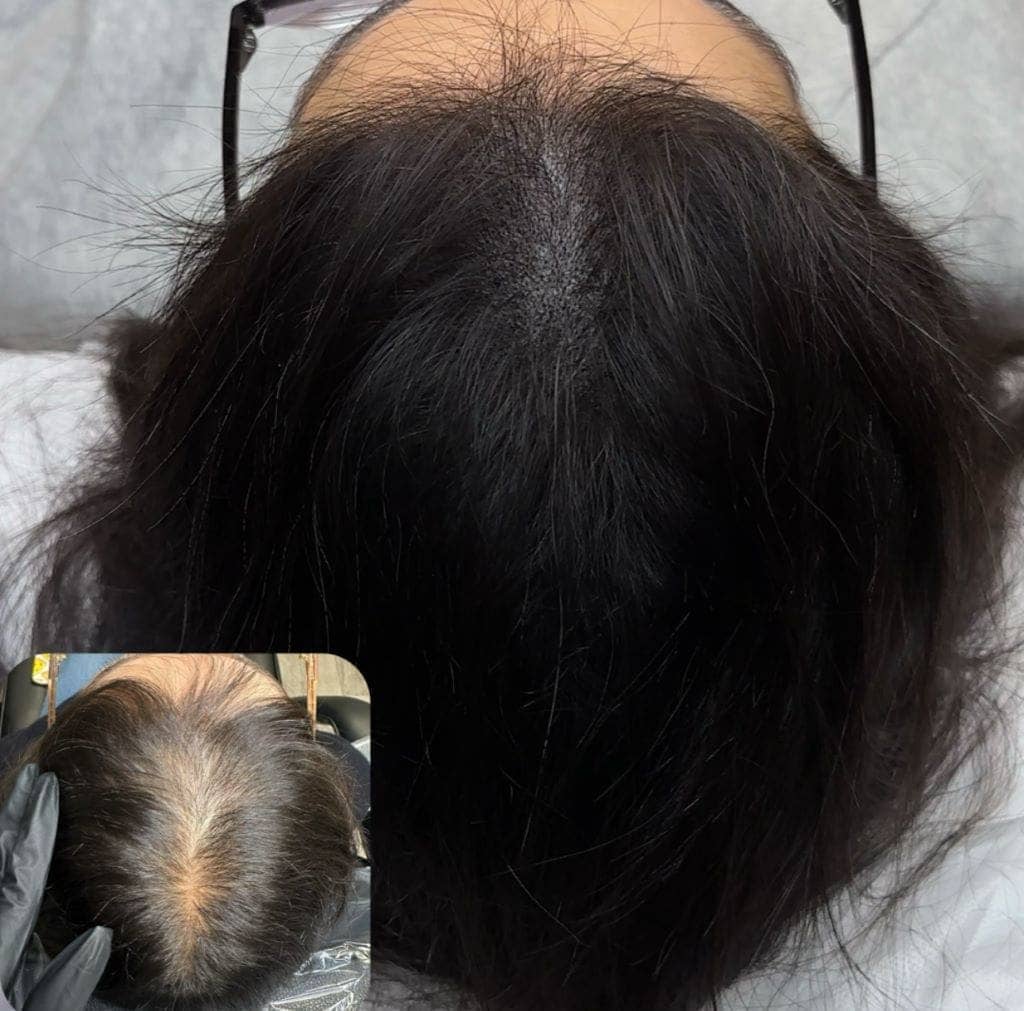
Scalp Micropigmentation result on woman's hair part.

Session Two: Building Density

Scheduled 1-2 weeks after your initial treatment, the second appointment adds depth and dimension. This session typically takes 2-3 hours as we refine coverage and enhance density where additional definition proves necessary. We assess the settled colour and make any necessary adjustments to shade or placement.

Session Three: Perfecting Details

The final session occurs 3-4 weeks after your second treatment, lasting 1-2 hours. This appointment addresses any spots requiring additional dots, refines the hairline’s softness, and ensures seamless blending between treated and natural sections. The result should appear as though you naturally possess denser hair growth rather than having undergone a cosmetic procedure.

Ready to start your three-session journey?

Visible results from the first session. Full transformation in 30-45 days. Book a free consultation with Will Quaye to map out your personalised treatment plan — hairline design, density goals, and realistic timeline.

Recovery Expectations and Aftercare

Initial redness and minor tenderness typically subside within 24-72 hours following each session. The first four days prove absolutely critical for optimal retention. Avoid activities that induce sweating, as perspiration contains salt that can draw out freshly deposited pigment.

Full healing spans 28-50 days, though you’ll return to normal activities much sooner. Avoid swimming pools and saunas for roughly four weeks, as chlorine and extreme heat can affect pigment retention. Sun exposure should be minimised or managed with SPF protection to prevent premature fading.

The treated scalp may scab slightly during the healing process. Never pick these scabs, as removal can lift pigment and create patchy results requiring correction. Professional aftercare guidance extends beyond these initial weeks. We provide detailed instructions tailored to your specific treatment and skin type.

Benefits Beyond Physical Appearance

The psychological impact often exceeds the visible change. Women describe liberation from constant mirror checks and strategic lighting arrangements. Your morning routine simplifies considerably when hair density concerns no longer dictate styling choices.

Professional confidence receives a notable boost. Client-facing roles and video calls become less anxiety-inducing. Dating and social situations shift completely. You stop avoiding certain hairstyles or declining swimming invitations due to hair concerns.

Physical convenience matters tremendously. Unlike hair systems requiring daily removal, your enhanced density remains permanent. Swimming, sleeping, and exercising occur without special considerations once healing is complete. Touch-ups every 3-5 years prove more economical than continuous product repurchasing.

Scalp micropigmentation for women provides detailed information about our specific approach and philosophy.

Potential Considerations and Realistic Expectations

Every cosmetic procedure carries considerations worth knowing beforehand. Mild discomfort during treatment remains possible, though most women rate it between 2-5 on a pain scale. Topical numbing agents help, and you can request breaks throughout longer sessions.

The results create an illusion of denser hair rather than actual follicle regrowth. This distinction matters tremendously for expectation management. Your treated sections will appear fuller, but you cannot grow the pigmented dots long or style them differently. The technique works brilliantly for women maintaining shorter styles or seeking density enhancement behind existing longer hair.

Maintenance requirements deserve consideration. Touch-ups every 3-5 years maintain optimal appearance as natural pigment fading occurs. This gradual lightening actually proves beneficial, as your aesthetic preferences may evolve over time.

Why Professional Expertise Matters Tremendously

Your practitioner’s qualifications directly impact your satisfaction and safety. Traditional tattoo artists lack the specialised training required for realistic follicle simulation. Hair loss knowledge and scalp anatomy expertise separate qualified practitioners from those simply offering cosmetic tattooing.

Our lead artist holds dual qualifications as both an advanced SMP practitioner and a Clinical Trichologist. This ensures your treatment benefits from both artistic mastery and medical-grade scalp health knowledge. Equipment quality affects results profoundly. Specialised micro-needles and digital rotary systems deliver precision impossible with standard tattoo equipment.

Portfolio examination reveals an artist’s true capabilities. Look for realistic, natural-looking results across various skin tones. Harsh hairlines or uniform dot patterns indicate inexperience.

A trusted trichologist in London can assess your scalp health and determine optimal treatment timing for your unique situation.

What Results Can You Actually Expect?

The change becomes visible immediately following your first session. The substantial shift in density provides instant gratification unlike treatments requiring months of patience. Your mirror reflection shows fuller coverage that continues improving across subsequent appointments.

The appearance remains consistent across all conditions. Swimming doesn’t wash away your enhanced density. Sleep doesn’t require special pillowcases. Intense workouts proceed without coverage concerns.

Natural fading occurs gradually over 2-5 years. The pigment lightens to softer versions of the original shade. Touch-up sessions restore vibrancy whilst allowing adjustments reflecting your current preferences.

Reclaiming Your Mental Freedom

Perhaps the most liberating aspect of hair tattoo for women lies not in the physical transformation itself, but in the mental space it returns to you. Those morning minutes previously spent anxiously arranging hair to hide thinning patches become available for more meaningful pursuits. Your confidence stops depending on lighting conditions, weather forecasts, or remembering your hair fibres that morning.

Reclaim your mornings, your confidence, your freedom

Book a free consultation with Will Quaye and find out exactly what hair tattoo for women can achieve for your specific case. Thirty minutes, in-person or video — no pressure, no obligation.

FAQ

The procedure proves effective across all hair types, textures, and colours. Pigment customisation ensures seamless blending with blonde, brunette, red, grey, or black hair through precise colour matching during consultation.

Absolutely. The treatment enhances density at your hairline or crown whilst existing longer hair grows naturally. Many women maintain longer styles and simply gain confidence from the improved fullness visible in ponytails and updos.

Quality practitioners offer correction sessions if needed, though proper consultation and realistic expectation setting minimise dissatisfaction. Laser removal remains possible should you desire complete reversal, though the shallow pigment placement makes this rarely necessary.

Properly executed procedures protect existing follicles through shallow pigment placement above the follicle depth. The micro-needling effect may even stimulate growth in some cases, though this represents a potential bonus rather than the primary objective.

What Makes a Great SMP Artist for Scalp Micropigmentation

Choosing the right scalp micropigmentation artist can mean the difference between a natural-looking hairline and an obvious tattoo. The best SMP artist UK professionals combine technical precision with artistic vision to create results that enhance your appearance rather than draw unwanted attention. When you’re investing in your confidence and appearance, knowing what separates exceptional practitioners from average ones becomes essential to your decision-making process.

Key Takeaways

  • Technical training and certification from recognised institutions demonstrate an SMP artist’s commitment to proper technique and safety standards
  • Portfolio diversity showing various hair types, skin tones, and scalp conditions reveals an artist’s versatility and experience level
  • Hairline customisation skills including both defined and soft techniques ensure results that match your facial features and age appropriately
  • The client consultation approach indicates how well an artist listens to your concerns and sets realistic expectations for outcomes
  • Hygiene protocols and equipment quality directly impact both safety and the longevity of your results
  • Ongoing education in the latest pigmentation techniques shows dedication to staying current in this evolving field

Training and Certification

Not every tattooist makes a skilled SMP artist. Scalp micropigmentation requires specialised training that differs significantly from traditional tattooing. The best scalp micropigmentation artist in UK clinics completes extensive programmes covering skin anatomy, pigment chemistry, and needle depth control.

Certification from recognised bodies signals a practitioner’s commitment to industry standards. An artist who openly discusses their training background demonstrates transparency and professionalism. Whether you’re seeking scalp micropigmentation for men or other treatments, verified credentials provide peace of mind.

Artistic Vision Meets Technical Precision

Technical skill alone doesn’t create exceptional results. The best SMP artist combines steady hand control with an artistic eye for natural patterns and density gradients. They replicate how hair follicles grow at different angles across the scalp by precisely placing pigment.

Look for practitioners who customise their approach rather than applying a generic template. Your hairline shape should complement your facial structure and age. A 25-year-old requires a different aesthetic than a 55-year-old. Some clients benefit from a defined hairline with crisp edges, whilst others need a softer, more diffused approach that mimics gradual thinning patterns.

Portfolio Assessment: What to Look For

A detailed portfolio reveals more than before-and-after photos. Examine how an SMP artist handles various challenges: receding temples, crown thinning, complete baldness, and scar camouflage.

Pay particular attention to hairline work. Natural hairlines feature irregular, slightly asymmetric patterns rather than perfectly straight lines. If every portfolio image looks nearly identical, the artist might lack the adaptability needed for your situation. Close-up photos demonstrate dot consistency, whilst wide-angle shots show how results appear in normal viewing conditions. The best portfolios demonstrate versatility across different client needs, from scalp micropigmentation for women to various male pattern treatments.

Communication and Expectation Setting

Exceptional SMP artists invest significant time in consultation before touching your scalp. They ask about your lifestyle, career, and personal goals for treatment. This conversation helps them design an approach tailored to your circumstances rather than their standard procedure.

During consultations, top practitioners discuss limitations honestly. They explain which outcomes scalp micropigmentation can achieve and which fall outside its scope. The best scalp micropigmentation artist in the UK will offer to book a free consultation where you can see their workspace, meet the team, and discuss your specific concerns without obligation.

A doctor wearing gloves examines the back of a patient’s head during a hair transplant consultation.

Equipment Standards and Hygiene Protocols

Professional-grade equipment produces superior results compared to budget alternatives. Quality SMP machines offer precise needle depth control, preventing pigment from penetrating too deeply or sitting too shallow. Both extremes create problems: deep pigment spreads and turns blue-grey, whilst shallow pigment fades quickly.

Single-use, sterile needles for every client represent non-negotiable safety standards. An SMP artist who maintains spotless facilities and follows strict hygiene protocols protects your health whilst demonstrating professional pride. Reputable clinics use medical-grade pigments formulated specifically for scalp work.

Specialisation and Continuing Education

The field of scalp micropigmentation evolves as new techniques and pigment formulations emerge. Artists who attend advanced training workshops stay current with innovations that improve results. Some scalp micropigmentation artists in UK clinics develop particular expertise in scar camouflage or hairline restoration.

The best SMP artist UK clinics often contribute to the field through teaching or presenting at industry events. Many also collaborate with hair loss specialists, including a trusted trichologist in London to provide clients with complete scalp health assessments.

Client Reviews and Testimonials

Authentic client feedback provides insight into the full treatment experience beyond portfolio photos. Look for reviews mentioning communication quality, comfort during sessions, and long-term satisfaction.

Pay attention to how practitioners respond to criticism. Professional artists address concerns constructively and offer solutions when clients face challenges. Video testimonials carry particular weight because they’re harder to fabricate than written reviews.

Final Thoughts

The relationship between client satisfaction and artist expertise runs deeper than technical ability alone—it encompasses communication, artistic sensibility, and genuine care for each person’s unique circumstances. When you find a practitioner who listens carefully, demonstrates consistent results across diverse clients, and approaches your treatment as a collaborative process rather than a transaction, you’ve likely identified someone capable of delivering the confidence-boosting results you’re seeking.

FAQ

A defined hairline creates a crisp, clear edge, suitable for younger clients or those who prefer a bold look. A soft hairline uses varying dot sizes and densities to create a graduated, natural-looking transition that mimics how hair naturally thins along the hairline. Most experienced artists customise their approach based on your age and facial features.

Price reflects experience, equipment quality, and skill level. Whilst you needn't choose the most expensive option, unusually low prices often indicate corners being cut in training, materials, or safety protocols. Quality scalp micropigmentation represents a long-term investment in your appearance.

Most clients require 2-3 sessions spaced several weeks apart to achieve optimal density and colour matching. Be cautious of artists promising complete results in a single session, as this often produces unnatural-looking outcomes.

Ask about their specific training in scalp micropigmentation, how many procedures they've completed, what pigments they use, and how they customise hairlines. Request to see healed results rather than just immediate post-treatment photos.

Experienced practitioners can often improve unsatisfactory results through colour correction, density adjustment, or laser removal followed by proper application. Look for artists with specific experience in corrective procedures if you're addressing previous poor results.

Is SMP for Women the Right Solution for Thinning Hair?

scalp micropigmentation for women before and after

Women’s hair loss affects nearly half of all women by age 50, yet it remains a largely unspoken struggle. Unlike male pattern baldness, female hair loss presents as gradual, diffuse thinning across the crown and part lines, making it harder to address with traditional treatments.

The psychological impact extends far beyond aesthetics. Research shows that women’s hair loss affects self-perception more profoundly than in men, influencing career confidence and social interactions. Many women find themselves avoiding situations, spending excessive time on styling, or investing heavily in temporary solutions.

While the beauty industry offers countless products promising fuller hair, many women find these inadequate for significant thinning. Traditional treatments like minoxidil require months to show results, and hair transplants aren’t always suitable for female patterns of women’s hair loss.

This gap has led to the emergence of scalp micropigmentation as a revolutionary solution, evolved specifically to address women’s unique aesthetic needs when dealing with hair thinning.

Before and after hair density treatment for female hair thinning, showing visible improvement in scalp coverage and hair volume.

Female Hair Loss By the Numbers

📊 The Reality Check:

  • 40% of women experience visible hair loss by age 40
  • 50% of post-menopausal women show signs of women hair loss
  • Only 12% of women seek professional treatment (vs. 47% of men)

🔍 Primary Causes:

  • Androgenetic alopecia (genetic predisposition)
  • Hormonal changes (pregnancy, menopause, PCOS)
  • Medical treatments and medications
  • Stress and nutritional deficiencies
  • Overstyling and chemical damage

💡 Why It Matters: Research indicates that women hair loss creates significantly more distress than male hair loss, with 94% of affected women reporting decreased self-confidence and 67% avoiding social situations.

⏰ The Timeline Problem: Traditional treatments like minoxidil take 6-12 months to show results, while many women need immediate confidence restoration.

Get a free, no obligation consultation

Click below to book your free consultation today, and take the first step toward a stronger, fresher, happier you.

SMP Decoded: Your Essential Questions

Q: What is Scalp Micropigmentation For Women?

A: A non-surgical cosmetic procedure using specialized micro-needles to deposit pigment into the scalp’s upper dermis, creating the appearance of natural hair follicles.

Q: How does women’s SMP differ from men’s treatment?

A: SMP for hair loss in women focuses on density enhancement rather than creating buzz-cut illusions. Techniques accommodate longer hairstyles and address diffuse thinning patterns.

Q: What’s the pain level?

A: Most clients rate discomfort between 2-4 on a 10-point scale. Topical numbing agents minimize sensation during treatment.

Q: How many sessions are needed?

A: Typically 2-3 sessions spaced 10-14 days apart, allowing proper healing and gradual density building.

Q: What about longevity?

A: Results last 3-5 years before requiring touch-ups, varying based on skin type, lifestyle, and sun exposure.

Q: Can I maintain my current hairstyle?

A: Yes, SMP for hair loss in women works with most hair lengths and styles, though optimal results are achieved with layered cuts that blend naturally with the treatment.

The Treatment Process Step-by-Step

PHASE 1: CONSULTATION (Week 1) Professional assessment includes scalp analysis, pigment matching, and treatment planning. Essential to find a trusted trichologist in London or a certified SMP practitioner.

PHASE 2: DESIGN MAPPING (Week 1) Practitioner creates detailed treatment map, marking density zones and establishing pigment placement strategy.

PHASE 3: FOUNDATION SESSION (Week 2) Initial pigment application establishes base coverage. Session duration: 2-4 hours dependi ng on treatment area.

PHASE 4: DENSITY BUILDING (Week 4) Second session adds depth and refines coverage, typically 10-14 days post-initial treatment.

PHASE 5: PERFECTION SESSION (Week 6) Final session (if needed) addresses any gaps and ensures uniform appearance.

Treatment Comparison Matrix

Treatment Option Initial Cost Annual Cost Recovery Timeline Success Rate Suitable For
SMP £2,500-4,000 £0 1 week Immediate 95%+ All hair loss stages
Hair Transplant £8,000-15,000 £0-500 2-4 weeks 6-12 months 85-95% Good donor hair
Minoxidil £200-400 £200-400 None 6-12 months 60-70% Early-stage loss
Platelet Therapy £1,500-3,000 £500-1,000 2-3 days 3-6 months 70-80% Active follicles
Hair Systems £2,000-5,000 £3,000-6,000 None Immediate 100% visual All stages

Key Advantages of SMP:

  • No ongoing medication requirements
  • Predictable, consistent outcomes
  • Compatible with active lifestyles
  • Works regardless of existing SMP for hair loss in women progression stage

When SMP Excels: Advanced women’s hair loss, insufficient donor hair for transplants, preference for non-surgical solutions.

Benefits vs. Limitations of SMP treatment for Women

✅ PRIMARY ADVANTAGES:

  • Immediate visual transformation
  • No surgical risks or extensive recovery
  • Weather and activity resistant
  • Suitable for all women’s hair loss patterns
  • Scar micropigmentation addresses surgical scarring
  • Cost-effective long-term solution

❌ KEY LIMITATIONS:

  • Creates appearance, not actual hair growth
  • Best suited for shorter to medium-length styles
  • Requires periodic maintenance (3-5 years)
  • Limited effectiveness on very light/blonde hair
  • Not suitable during active scalp conditions

⚠️ IMPORTANT CONSIDERATIONS:

  • Results depend heavily on practitioner skill
  • Color may shift slightly over time
  • Some medications can affect pigment retention
  • Lifestyle factors (sun exposure, skincare products) impact longevity

CONTRAINDICATIONS: Active psoriasis, eczema, keloid scarring tendency, certain autoimmune conditions, or current chemotherapy treatment.

Scalp Micropigmentation Transformation Before And After

Making Your Decision

Deciding whether SMP is right for you isn’t just about comparing costs or reading success stories. It’s about understanding how this treatment fits into your life, your expectations, and your relationship with your appearance.

Consider your daily routine first. If you’re someone who spends significant time styling your hair each morning or constantly worries about wind, rain, or swimming affecting your look, SMP could offer tremendous freedom. However, if you love experimenting with drastically different hairstyles—from pixie cuts to long waves—SMP’s visual requirements for shorter, layered styles might feel restrictive.

The financial aspect extends beyond the initial investment. While SMP for hair loss in women typically costs $2,500-4,000 upfront, compare this to years of specialty products, frequent salon visits, or high-quality wigs. Many women find that SMP actually saves money over time while eliminating daily styling stress.

Your treatment goals matter enormously. If you’re seeking to address women’s hair loss primarily for confidence restoration and don’t mind that SMP creates the appearance rather than actual hair growth, you’re likely a good candidate. However, if you’re hoping for a solution that will allow you to grow long, flowing hair again, a hair transplant might better align with your expectations.

Be honest about your motivations and timing. Making cosmetic decisions during emotionally vulnerable periods often leads to regret, regardless of the treatment quality.

Next Steps and Action Plan

If you’re seriously considering SMP for hair loss in women, the research phase is crucial. Start by identifying practitioners in your area who specifically showcase female hair loss treatments in their portfolios. Look for before-and-after photos that demonstrate work on women’s hair loss patterns similar to yours, paying attention to how natural the results appear with different hair lengths and styles.

Schedule consultations with at least two practitioners before making any decisions. During these meetings, assess not only their technical expertise but also their understanding of female aesthetic concerns. A skilled practitioner should be able to explain how they’ll adapt their technique to work with your existing hair and lifestyle preferences. Don’t hesitate to ask about their experience, training, and what happens if you’re unsatisfied with the results.

Prepare thoughtful questions about aftercare, touch-up requirements, and long-term expectations. Discuss any medications you’re taking, skin sensitivities, or medical conditions that might affect treatment outcomes. If you have very fair or blonde hair, specifically address how well SMP will work with your coloring.

Trust your instincts during consultations. The practitioner you choose will be creating a semi-permanent change to your appearance, so feeling confident in their abilities and comfortable with their approach is essential. Quality should always take priority over cost when it comes to SMP for hair loss in women—this investment in yourself deserves the best possible outcome.

What’s the Difference Between a Defined and Soft Hairline?

Your hairline tells a story before you say a word. Sharp edges versus gradual fade. Geometric precision versus organic randomness. The choice shapes how people perceive your results — and whether they notice them at all.

We get asked this question constantly. Men arrive at our Essex clinic clutching photos of celebrities, pointing to hairlines they admire. “Can you do this?” they ask. Sometimes yes. Often, we recommend something better.

Here’s the truth most SMP clinics won’t tell you: not every hairline suits every face.

The Defined Hairline: When Precision Works

Defined hairlines create clear boundaries. The border between scalp and forehead appears deliberate, almost architectural. Each dot follows measured lines.

This style delivers structure. Younger clients often request it. They’ve seen the sharp fades in barbershops, the precise lineups their barbers create weekly. They want that same crisp finish, made permanent.

Does precision automatically mean fake-looking? No. But it requires exceptional skill.

Characteristics:

  • Clean edges with minimal irregularity
  • Consistent dot density right to the border
  • Geometric approach to placement
  • Bold, masculine aesthetic
  • Works best with short buzz cuts maintained regularly

The challenge? Human hairlines rarely grow with mathematical precision. Natural follicles cluster irregularly. Density varies. Spacing changes unpredictably across the scalp.

Defined styles can work brilliantly — when they match the client’s facial structure, age, and existing hair pattern. Square faces handle sharp edges well. The angularity complements strong jawlines. Round faces benefit from added structure that defined borders provide.

Age matters here. Men under 35 can usually carry off precision without appearing artificial. Their facial features still possess the sharpness that complements geometric hairlines. After 40? Different story. Faces soften with age. Skin texture changes. Overly precise hairlines start looking incongruous against maturing features.

We’ve seen defined hairlines done poorly. The “stamped-on” appearance where every dot aligns perfectly. The ruler-straight borders that scream “artificial.” These results happen when practitioners prioritise speed over artistry, following templates rather than customising for individual scalps.

The Defined Hairline: When Precision Works

Soft Hairlines: Our Speciality at Scalp Nation

We don’t specialise in razor-sharp, barber-style hairlines. Never have. Our philosophy centers on bespoke, natural, and undetectable results.

Soft hairlines mimic how hair actually grows. Irregular patterns. Variable density. Strategic imperfection. This approach creates authenticity that withstands scrutiny under any lighting, from any angle.

What makes soft hairlines different:

  • Irregular borders with deliberate variation
  • Gradual density reduction at edges
  • Random dot placement mimicking natural follicle distribution
  • Undetectable finish
  • Versatile across different scalp conditions

The transition zone receives our closest attention. We don’t maintain uniform density right to the edge. Instead, dots gradually decrease in concentration. Spacing increases. Some areas receive clusters, others individual marks spaced further apart.

This randomness isn’t accidental. It’s calculated. Will Quaye, a trusted trichologist in London with over six years treating clients from 19 countries, developed our soft technique based on trichological principles about how hair actually grows.

Natural hairlines never begin abruptly. They fade. Biology creates transition zones where follicles thin gradually before meeting bare forehead skin. Our soft technique replicates this biological reality.

Men seeking ultimate discretion choose soft styles. They want colleagues, partners, even close friends unable to detect their SMP. They want results that photograph naturally in harsh sunlight, not just controlled studio lighting. They want to pass the “close inspection” test — because life brings us into close proximity with others constantly.

This approach demands more artistry than following structured patterns. Creating convincing randomness requires deep knowledge of hair growth biology. Where do follicles naturally cluster? Which irregularities appear authentic? When does variation cross into obviously artificial territory?

Scalp micropigmentation for men using soft techniques blends seamlessly with existing hair. Clients who still have significant coverage but want density enhancement benefit enormously. The irregular SMP dots integrate with real follicles so thoroughly that even trained eyes struggle to distinguish where nature ends and artistry begins.

Older clients overwhelmingly prefer this approach. Their biological hairlines have already begun the irregular recession process. Matching that natural maturation pattern creates age-appropriate results that respect the broader ageing process rather than fighting it.

Soft Hairlines: Our Speciality at Scalp Nation

Who Benefits Most From Each Style?

We assess every client individually during consultations. No two scalps are identical. Neither are two faces, lifestyles, or sets of expectations.

Soft hairlines suit:

Men with existing hair seeking density enhancement. The irregular technique integrates perfectly, creating seamless transitions between real follicles and pigmented dots.

Anyone in conservative professional environments. Bankers, solicitors, corporate executives — professionals where appearing “done” creates career complications.

Clients over 40. Biological reality dictates that mature faces suit natural irregularity better than geometric precision.

Those with lighter skin tones. Reduced contrast allows for more forgiving results. Gradual density fading at edges appears less stark against fair skin.

Defined hairlines work for:

Younger men comfortable making aesthetic statements. If you’re 28, working in creative industries, maintaining meticulous grooming — precision might complement your overall presentation perfectly.

Those keeping extremely short buzz cuts permanently. When everything’s cropped uniformly, consistent density across the entire scalp can actually appear more natural than graduated softness.

Clients with darker skin tones who want bold results. Higher natural contrast permits more dramatic artistic choices without crossing into artificial territory.

Your lifestyle matters enormously. Athletic men who swim daily need different considerations than office workers who rarely see harsh outdoor lighting. We factor in how you’ll actually live with your results, not just how they appear during your consultation.

Who Benefits Most From Each Style?

How We Create Each Effect

The technical execution differs fundamentally between approaches. Equipment choices, stroke patterns, pigment selection — everything shifts based on desired outcome.

For defined work, practitioners map borders using facial measurements. Symmetry calculations determine placement. The first session establishes outer edges — dots placed at regular intervals maintaining uniform density. Subsequent sessions build depth through layered applications.

Soft techniques start broader. We establish general zones rather than precise borders. Dot placement follows no rigid pattern. Spacing varies deliberately. Pressure changes mid-stroke. Needle angles shift to produce different dot characteristics within the same small region.

We switch between needle configurations during sessions. Small setups create tight clusters. Larger ones produce more dispersed marks. This variation generates the dimensionality that convincing softness requires.

Pigment selection matters too. We typically begin with lighter shades for soft styles, building gradually across sessions. This layered approach allows for nuanced adjustments, creating natural colour variation that mimics how real hair follicles display subtle tone differences.

The process takes longer. Soft techniques demand more artistic decision-making per square centimetre than following structured patterns. But the results justify the additional time investment.

How We Create Each Effect

Making Your Decision

Your scalp tells us what works. Facial structure, skin tone, existing hair pattern, age — these factors determine which technique delivers the best results.

We don’t follow templates. Some clients need soft irregularity across the entire hairline. Others benefit from hybrid approaches — defined structure along temples transitioning to randomness at the front. Touch-up sessions allow modifications if your preferences shift over time.

Book a free consultation to discuss your specific situation. Bring reference photos showing styles you like and ones you definitely want to avoid.

FAQ

Defined edges can appear less authentic on older faces since biological hairlines naturally become irregular with age, which is why many clients request softening during touch-ups in their 40s.

Soft hairlines photograph better under harsh lighting because irregular density prevents the "dotted line" appearance that defined edges can show in bright sunlight or flash photography.

Touch-up sessions allow modifications — softening defined edges is straightforward through adding irregular dots beyond existing borders.

Natural hair growth patterns vary across ethnicities, so we assess individually, though men with lighter skin tones often achieve superior results with soft techniques.

Scalp Micropigmentation for Darker Skin

Resident scalp micropigmentation practitioner Will Quaye hard at work

Darker-skinned individuals often hesitate before pursuing scalp micropigmentation, wondering if the treatment will look natural on their complexion. Questions about technique differences, pigment selection, and finding qualified practitioners create understandable uncertainty. The truth? Scalp micropigmentation for darker skin produces exceptional results when performed correctly. The treatment requires specialized knowledge and adjusted techniques, but darker complexions actually offer distinct advantages for longevity and visual impact. Understanding these differences helps you make confident decisions about restoring your hairline and addressing hair loss concerns that affect your daily confidence.

SMP for darker skin

Key Takeaways

  • Darker skin requires larger follicle replications and increased pigment volume to match naturally thicker hair
  • Specialized pigment selection with warm undertones creates authentic appearances that avoid color shifting
  • SMP typically lasts 3-5+ years on darker skin tones—longer than lighter complexions
  • Qualified practitioners adjust machine settings, needle depth, and dot spacing for optimal results
  • Sharper, more defined hairlines often complement darker skin tones while slower fading extends treatment longevity

Does Scalp Micropigmentation Actually Work for Darker Skin Tones?

SMP delivers outstanding results across every skin tone. Hair follicles appear larger on darker skin compared to lighter complexions, meaning African, Afro-Caribbean, Asian, Indian, and Middle Eastern individuals need tailored approaches that create advantages rather than limitations.

Larger follicles retain pigment more effectively, translating to longer-lasting results. The treatment remains equally safe and effective—just different in execution. Dark skin smp actually offers better pigment stability and reduced fading compared to lighter tones. The contrast between scalp and pigment creates bold, defined appearances that look incredibly natural when executed properly.

Hair types common among darker-skinned individuals—coily, kinky, or tightly curled—naturally grow in denser patterns that SMP replicates beautifully. When practitioners understand how to work with these characteristics, they create results that fool even close observers. The key lies in finding artists who specialize in diverse skin tones rather than applying one-size-fits-all techniques.

Many clinics now recognize that smp for darker skin demands different equipment settings, pigment formulations, and artistic approaches. This specialization means better outcomes for clients who previously worried about whether the treatment would suit their complexion. Scalp micropigmentation for men has evolved significantly, with techniques now accommodating the full spectrum of skin tones and hair textures.

What Makes the Dark Skin SMP Process Different?

The dark skin smp process demands technical precision beyond standard application methods. Understanding these differences separates practitioners who create stunning results from those who produce disappointing outcomes.

Naturally thicker hair requires larger pigment deposits that mirror actual follicle diameter. Too small creates sparse, unconvincing results. Too large produces a flat, painted appearance instead of dimensional hair stubble. Experienced technicians know exactly how much pigment achieves saturation without overshooting into unnatural territory.

More ink fills larger follicles properly without creating safety concerns—it simply matches your natural hair characteristics. This increased volume doesn’t cause side effects; it’s merely adapting the treatment to your biological reality. Needle penetration depth, insertion angle, and pressure must all adjust to prevent pigment from spreading beneath the skin surface, which creates blurry, merged dots.

Critical dot spacing separates experienced practitioners from amateurs. Improper spacing causes neighboring dots to merge during healing, creating solid patches instead of individual follicles. Skilled artists calculate precise spacing that accounts for how pigment behaves in darker skin tissue during the settling process.

Building depth requires multiple sessions with strategic layering, adding density and dimension gradually. Each pass builds on the previous work. Rushing this process or compressing treatments into fewer sessions compromises the final appearance dramatically.

When practitioners ignore these adjustments, clients end up with flat, unconvincing coverage that screams “cosmetic procedure” rather than natural hair stubble. Merged pigment becomes difficult to correct without extensive laser removal.

How Do You Choose the Right Pigment Shade?

Pigment selection separates amateur work from professional artistry. The wrong shade creates obvious, unnatural results that age poorly over time. Darker pigments with warm undertones complement deeper skin tones, preventing the blue or green color shifts that plague traditional tattoo inks. Carbon-based and iron oxide pigments maintain their intended shade throughout the fading process.

Smart practitioners start lighter than the target color, building gradually to allow adjustments between sessions. Going too dark initially requires laser intervention to correct. Artists anticipate natural fading and account for it in their initial color selection. Your natural hair color and skin undertone both guide the process, with cool undertones pairing differently than warm undertones.

Grayscale pigmentation creates the most natural shadow effect. Shaved hair appears gray regardless of original color—red hair shaved down shows gray stubble, as does black hair. Matching this natural gray scale rather than trying to replicate unshaved hair color produces superior results.

Test patches eliminate guesswork before full treatment. Quality clinics apply small sample areas so you see exactly how the pigment settles into your skin and how the color develops over several days. Traditional tattoo inks don’t belong anywhere near scalp micropigmentation due to unpredictable color changes and faster degradation.

Proper pigment selection becomes even more critical for scar micropigmentation on darker skin, where scar tissue accepts pigment differently than healthy scalp, requiring expert blending to achieve seamless camouflage.

scalp micropigmentation for darker skin

Should You Go Bold or Subtle with Your Hairline?

Hairline design for darker skin often favors sharper, more defined edges. This aesthetic preference stems from both cultural norms and technical realities. Crisp hairlines complement the strong contrast between darker skin and pigment, creating intentional, modern appearances rather than apologetic softness. Many clients appreciate this confident appearance that mirrors contemporary grooming standards.

Your natural hair type influences design decisions significantly. Coily or kinky hair creates dense, defined hairlines when grown out—replicating this through SMP maintains consistency with your hair’s natural behavior. Soft, feathered hairlines that work beautifully on straight, fine hair can look mismatched against naturally textured patterns.

Age considerations matter too. Younger clients typically want that sharp, fresh-cut appearance. Older clients might prefer slightly softer edges that suggest mature hairlines. Neither choice is wrong—personal preference drives the decision.

Popular Hairline Style Preferences:

  • Sharp/Defined: Clean edges that mirror fresh haircuts, popular among younger clients
  • Modern Fade: Gradual density transition creating contemporary dimension
  • Natural/Soft: Subtle irregularity mimicking organic growth patterns

Your practitioner should show examples across this spectrum and discuss which option best suits your facial structure and lifestyle. Beware anyone pushing a single “house style” regardless of your preferences or unique characteristics.

What Should You Expect During Healing and Recovery?

Recovery on darker skin follows similar timelines with specific considerations that affect visible healing stages. Initial redness appears as darker discoloration on deeper skin tones rather than bright red inflammation, typically resolving within 24-72 hours. Some clients experience color changes for up to five days depending on skin sensitivity.

Scabbing occurs during normal healing—don’t pick at these scabs as doing so pulls out pigment and creates patchy results requiring additional touch-ups. Let them fall away naturally over 7-10 days. This patience pays dividends in the final appearance.

True color development takes patience on scalp micropigmentation for darker skin. The final shade won’t appear for several weeks as pigment fully settles beneath the surface. Initial darkness fades to your intended tone as healing completes, which is why starting lighter proves beneficial.

Post-Treatment Care Essentials:

  1. Days 1-4: Avoid sweating, swimming, and sun exposure; keep scalp dry and clean
  2. Days 5-10: Gentle washing allowed; scabs fall naturally without interference
  3. Weeks 2-4: Continue sun protection; avoid heavy exercise that causes sweating
  4. Weeks 4-6: Full healing achieved; final color visible and ready for assessment

Keloid scarring risk exists for individuals predisposed to this condition, particularly those of African and Asian descent. Reputable clinics screen for this history during consultation. If you’ve developed keloids from previous injuries or piercings, discuss this upfront.

Sun protection becomes non-negotiable. UV exposure fades pigment prematurely, though darker skin’s natural melanin provides some protection. Sunscreen or hats preserve your investment and extend longevity.

How Long Will Your SMP Last on Darker Skin?

Smp for darker skin typically outlasts results on lighter complexions. Expect 3-5+ years before needing significant touch-ups, compared to 2-4 years for fairer skin.

Darker skin retains pigment more tenaciously. Larger follicle impressions contain more ink, providing greater volume that fades slowly. Melanin-rich skin offers natural UV protection that preserves pigment integrity.

Fading occurs gradually over years rather than suddenly. Touch-ups every few years restore vibrancy and adjust for any natural hair loss progression. Maintenance requirements remain minimal—no daily applications or system replacements needed.

Sun exposure affects longevity, though darker skin tolerates UV better. Regular sunscreen or hat-wearing extends time between touch-ups. Cost-effectiveness improves with longer-lasting results, reducing total lifetime expenditure.

Get a free, no obligation consultation

Click below to book your free consultation today, and take the first step toward a stronger, fresher, happier you.

What Makes a Practitioner Qualified to Work with Darker Skin?

Red flag: any technician claiming “the process is exactly the same for everyone.” This reveals fundamental ignorance about how skin type affects technique.

Portfolio examination tells the truth. Request before-and-after photos of clients with similar skin tones. Study the hairline sharpness, dot consistency, and overall naturalness for signs of merged pigment or flat, painted appearances.

Essential Questions During Consultation:

  • How many clients with my skin tone have you treated?
  • What specific adjustments do you make for darker skin?
  • Can I speak with previous clients who have similar complexions?
  • What pigments do you use, and why are they appropriate for my skin?

Understanding of coily, kinky, and tightly curled hair types separates good practitioners from great ones. Trichology knowledge provides added confidence—clinical trichologists understand scalp health and how skin responds to treatments. Scalp Nation’s Will Quaye combines award-winning SMP artistry with clinical trichology qualifications, providing the dual expertise that produces exceptional results.

dark skin smp

Can SMP Fix Previous Bad Work on Darker Skin?

Poor technique becomes obvious quickly on darker skin. Merged dots, incorrect pigment colors, and unnatural hairlines stand out prominently, but correction work shows improvement more dramatically.

Laser removal remains the primary solution for severely botched SMP. Modern picosecond lasers like PicoWay work safely on darker skin tones, using pressure waves rather than heat to reduce hyperpigmentation risk. Complete removal typically requires 4-8 treatments spaced several weeks apart.

Correction without full removal becomes possible when the original work isn’t catastrophically bad. Skilled practitioners can add strategic dots to improve spacing or blend problematic areas, saving time and money compared to complete removal.

Timeline expectations: full removal and re-treatment takes 6-12 months minimum. Patience becomes necessary when fixing previous mistakes.

Ready to Explore Your Options?

Scalp micropigmentation for darker skin creates remarkable transformations when performed by qualified practitioners who understand the technical nuances. Your skin tone provides advantages—better retention, longer-lasting results, and striking contrast that looks incredibly natural with proper technique.

The key lies in finding an artist with demonstrable experience across diverse skin tones. Don’t settle for generic approaches that ignore how your unique characteristics demand specialized methods.

Scalp Nation’s expertise in working with all skin types, combined with Will Quaye’s clinical trichology background, ensures you receive treatment tailored to your specific needs. See real examples, discuss your concerns, and get honest assessments during a free consultation.

Book your free consultation today to discover how scalp micropigmentation can restore your confidence with results that look authentically you.

FAQ

Darker skin requires adjusted follicle sizes, increased pigment volume, and precise dot spacing to prevent merging—mistakes that practitioners without specialized experience often make, creating visible problems that cost significantly more to correct.

Yes, SMP works beautifully for density enhancement through existing hair by applying pigment between your natural follicles to create fuller coverage without requiring a shaved head.

Quality SMP pigments don’t change color when applied properly—blue or green tints only occur when practitioners use traditional tattoo inks or place pigment too deep in the skin.

While certain ethnicities show higher keloid predisposition, SMP creates minimal trauma making keloid risk relatively low. Quality clinics screen for keloid history during consultation and adjust treatment plans accordingly.

What to Expect From Scalp Micropigmentation Before and After

smp benefits

Before-and-after photos pull more attention than anything else in scalp micropigmentation, and they get misread more than anything else, too. People scroll through galleries, land on one striking image, and quietly assume that’s what walking out of a single appointment looks like. It almost never is. A scalp micropigmentation before and after is the compressed sum of several sessions, days of healing, and weeks of the pigment settling into its true shade. 

You’ll learn:

  • What a single before-and-after photo leaves out, and why that matters before you book
  • What decides how dramatic your own result will look
  • How the finished look gets built across three sessions, and why the spacing isn’t even
  • How to read your own heal week by week and tell normal settling from a genuine fault
  • Why your result keeps changing for months after you walk out, and what that means long term

One Photo, Weeks of Work Behind It 

A before-and-after image is a summary, not a snapshot of one moment. Two frames sit side by side, and your eye fills in a clear cause-and-effect. Bald on the left, full on the right, done. The work that closed that gap stays invisible.

What got edited out is most of the story. The single hair micropigmentation before and after you’re looking at usually represents three appointments booked weeks apart, plus the healing that happens between each one. The “after” frame is shot once everything has calmed down and the colour has found its level, sometimes a month or more past the final session.

That gap matters for anyone weighing up the treatment. Judge it by the endpoint alone, and the early days can feel alarming, because the fresh scalp looks nothing like the polished photo that sold you on the idea. Learning to see the stages behind the image keeps expectations honest.

If you want the raw proof over the explanation, our transformations gallery holds the real client photo sets. This article is here to explain what you’re actually looking at.

How Does Hair Loss Type Affect the Visible Result?

How big the visible change looks comes down almost entirely to the starting canvas. Two clients can both get excellent work, and one before-and-after will still land far more dramatically than the other, purely because of where each man began.

Take a fully bald crown. Going from that to a dense, cropped look is the most eye-catching jump there is, which is why bald head micropigmentation dominates the galleries. The contrast is enormous, so the camera loves it. Diffuse thinning gives a quieter change, since the pigment fills between existing hairs without rebuilding an entire scalp.

Starting pointWhat the work doesHow the before-and-after reads
Fully bald crownRebuilds a dense, cropped hairline from scratchThe most dramatic jump, high contrast
Diffuse thinningFills pigment between existing hairs for densitySubtle, easy to miss in a photo
Transplant scarringBreaks up the pigment to blend the scar into the surrounding hairQuiet, judged by how invisible the scar becomes
Alopecia patchesMatches coverage to whatever hair remainsVaries with patch size and placement

Then there are the starting points that change the goal altogether. Scar tissue from a previous transplant needs the pigment broken up to blend a smooth patch into the surrounding density. Alopecia patches call for matching coverage to whatever hair remains around them.

None of this makes a subtle before-and-after a weaker result than a dramatic one, and that’s the part worth holding onto. A refined hairline that frames the face and a rebuilt crown are both strong outcomes. They simply photograph differently. The size of the visible change reflects your starting point, not the quality of the work, and quiet results pass closer inspection precisely because there’s less to give them away.

Get a free, no obligation consultation

Click below to book your free consultation today, and take the first step toward a stronger, fresher, happier you.

The Three-Session Climb to the “After”

The polished after photo gets built across roughly three sessions, not captured in one. There’s a reason it works this way. An artist could load the scalp with dark pigment on day one, but the result would sit too heavy, heal unpredictably, and leave no room to read how your skin actually holds colour.

Working up in layers solves that. Each visit has a clear job, and the table maps what happens against what you’ll actually see in the mirror.

SessionWhat happensHow it looks freshWhat you’ll judge later
FirstHairline mapped, base layer placedBold, sharp, darker than expectedHow evenly the base settles
SecondDensity built on healed workFuller, still intenseHow natural the coverage reads
ThirdRefinement and final blendingThe finished depth appearsThe true, settled colour

Most people notice a real difference after session one and see the biggest leap after session two.

The spacing between visits isn’t padding, and it isn’t even. Your first two sessions sit close together, around one to two weeks apart, which stacks early density quickly during the period your skin is still receptive. The gap before the third stretches longer, closer to three or four weeks, giving the scalp time to fully settle so the artist judges the final detailing against healed colour, not fresh pigment. That widening gap is the reason the day-one look differs so much from the finished one, a change worth grasping before you panic at your own reflection. We cover that swing in detail in our guide to fresh SMP versus healed SMP.

Scalp micropigmentation before and after

Is Your SMP Healing Normally? 

Most disappointment with SMP comes from misreading a perfectly normal heal as a failure. The early scalp behaves in ways that look wrong if nobody has warned you, so learning to read your own heal saves a lot of needless worry.

How a Healthy Heal Looks Week by Week

What you brace for first is darkness. Straight after a session, the pigment sits high in the skin and scabs form on top of each dot, so the scalp reads bolder and rougher than the final result ever will. That early intensity is depth and healing, not a sign the artist went too heavy. Here’s the path a normal heal follows:

  • Days 1 to 3: bold, dark dots with mild redness, the harshest the work will ever look
  • Days 7 to 10: tiny scabs over each dot shed, taking surface pigment with them and leaving the colour lighter
  • Weeks 2 to 3: the shade drops into its true depth and softens toward natural stubble
  • Weeks 3 to 4: the surface is smooth, even, and settled; this is your real result

A healthy heal lightens uniformly across the treated zone the whole way through, holding a consistent, realistic density without going patchy.

Signs Worth Flagging to Your Artist

All of this turns a good hair pigmentation before and after into something you read, not just admire. Most early oddness is ordinary healing, but a few changes point to a technique or pigment problem and deserve a message to your artist:

  • Patchy retention in place of an even, gradual lightening
  • A slide toward blue or grey tones, not a softer version of the original shade
  • Coverage that fades hard within months, when it should hold for years

Photograph your scalp under the same light every few days. A consistent record makes the difference between normal settling and a genuine fault easy to spot, and gives your artist something concrete to work from.

Why the Result Keeps Moving After Your Last Session 

The healed result isn’t frozen the day it’s declared finished. Plenty of before-and-afters get shot at the point where everything looks crisp, and that image becomes the reference. Your scalp keeps moving past it, slowly.

First comes settling. Across roughly the first month, the pigment finishes bedding into the skin and lands on its true shade, which is why most treatments read as complete somewhere around 30 to 45 days from your final session, not on the day you walk out. People see a clear difference far earlier, after the very first session, but that early density and the settled final colour are two separate milestones worth keeping apart in your head.

Then comes the long, slow lightening that every treatment goes through. Over the years, the pigment softens, which is normal for SMP, not a flaw in the original work. A periodic top-up brings the definition back. If you want the mechanics of why this happens and how to slow it, read why your SMP fades.

See the Whole Transformation in Motion 

A still image can only show you two points on a curve. Watching a change unfold in motion gives you what a before-and-after photo edits out. The texture, the angles, the way the pigment reads across a whole head and not just one flattering frame. The video below provides a full 360-degree view of the result, as close as you can get to seeing the work in person before you book.

See the Proof and Map Out Your Own 

The most useful skill you can bring to any gallery is knowing what a fair comparison looks like. A before shot and a healed after, taken weeks after the final session under matching light, tells you far more than a dramatic side-by-side photographed the day someone left the chair. Hold every result you see, and eventually your own, to that standard.

The best way to judge what SMP could do for you is to look at real, healed results and talk through your own scalp with someone who does this every day. Browse the transformations gallery for genuine client photos, then book a free consultation to map out what your own before-and-after could look like.

FAQ

Yes, noticeably. A photo taken right after a session shows bold, sharp pigment sitting on the surface. A healed photo, shot weeks later, shows the softened, settled colour that blends with the scalp. The healed version is the honest one, which is why reputable galleries lean on it.

For density work, yes. SMP placed to thicken thinning hair stays hidden underneath once you grow the hair back, adding the illusion of fullness at the root. A full shaved-look result is designed for short or shaved hair, so growing existing hair long over it won't suit that style the same way.

Honest clinics don't need to edit them, but the industry isn't free of it. The fairest way to vet a provider is to ask for healed photos in place of fresh-session shots, look for consistent lighting between the before and after, and check video testimonials, where editing is far harder to hide.

It can. Oily skin tends to soften pigment faster, and very dry skin may flake during healing, which affects how crisp the early result looks. A good artist factors your skin into pigment choice and depth, so your healed outcome lands where it should, regardless of type.