
If you’re reading this, the transplant probably didn’t turn out the way you expected. Maybe the donor area looks patchy, or a scar is now showing where the surgeon said it wouldn’t. That experience is far more common than most clinics admit.
Hair transplant scar camouflage using scalp micropigmentation (SMP) has become one of the most reliable non-surgical solutions — covering both FUE and FUT outcomes, without another procedure, another recovery, or another round of crossed fingers.
Key Takeaways
- FUE and FUT procedures leave distinctly different types of scars — and this affects how SMP is applied.
- SMP doesn’t erase a scar. It camouflages it — and a well-executed treatment can reduce visibility dramatically.
- FUE scar cases typically require 2–3 sessions; FUT strip scars are more involved and usually call for 3–4.
- There are situations where SMP won’t deliver good results — active donor-area loss, keloid scars, and extensive necrosis among them.
- The practitioner you choose matters more for scar work than for almost any other SMP application.
What Scars Does a Hair Transplant Leave?
Two procedures, two very different types of scarring — and knowing which one you’re dealing with directly shapes how scar camouflage after hair transplant is approached.
FUE and FUT both leave marks. The difference lies in their shape, location, and how each responds to treatment.
| FUE Scars | FUT Scars | |
| Shape | Small, circular punch marks | Single horizontal linear strip |
| Location | Scattered across the donor area (back and sides) | Lower back of the scalp |
| Visibility | Clear at shaved, or very short lengths | Varies — can widen, raise, or discolour |
| SMP approach | Moderate complexity — flat dots blend readily | Higher complexity — raised or wider tissue |
FUE is frequently marketed as the “scarless” option. That framing doesn’t hold up under a close look. Depending on how many grafts were removed and how aggressively the donor zone was treated, you can end up with dozens to hundreds of pale, circular dots running from ear to ear. At a grade one or two, they show clearly. Growing hair longer masks them at certain lengths, but that’s not a solution for anyone wanting to keep their hair short.
FUT leaves a single strip scar along the lower back of the scalp. Less widespread, but not necessarily easier to live with. Width and visibility depend on surgical technique and individual healing — some remain fine and flat, others raise or widen noticeably over time.
Both types are strong candidates for SMP for hair transplant scar work. The approach just looks different for each.
Identified your scar type? Get a free expert assessment
Will Quaye reviews both FUE and FUT scar cases — in-person or via photos. He’ll tell you straight whether your case is a strong fit and how many sessions to expect.
How Does SMP Camouflage Scars After a Hair Transplant?
Scalp micropigmentation deposits tiny dots of pigment into the upper layer of the scalp skin, each one replicating the look of a shaved hair follicle. On a healthy scalp, this creates the illusion of density or a closely cropped head. On scar tissue, the same logic applies, but the technique requires more care and more sessions to achieve a clean result.
Why Scar Tissue Responds Differently
Healthy scalp skin holds pigment in a predictable way. Scar tissue doesn’t. The structure of a healed scar is denser, less elastic, and often uneven in colour compared to the skin around it. Pigment absorbs inconsistently, which means a single session rarely produces the result you’re aiming for.
Layering is the answer. A skilled practitioner builds pigment gradually across multiple sessions, letting each layer settle before adding more. This layered process allows for precise colour matching and avoids the flat, oversaturated look that can come from rushing the work.
What “Camouflage” Means in Practice
SMP reduces the contrast between the scar and the surrounding scalp. It doesn’t remove the scar itself. A well-executed scar camouflage after hair transplant treatment typically achieves a 70-85% reduction in visual contrast.
For most clients, that shift is enough to change how they carry themselves. No more angling away from cameras. No more calculating where to sit in a room. Hair transplant scar camouflage done well removes the quiet mental weight that came with it.
What Can FUE Patients Realistically Expect from Scar Camouflage?
FUE dot scars respond well to SMP. They’re flat, relatively contained in size, and their scattered distribution works in the practitioner’s favour. Pigment deposits placed between and across the circular marks blend naturally into the surrounding follicle pattern. Of the two transplant scar types, FUE cases tend to produce the most consistent outcomes.
How Many Sessions Does FUE Scar Work Require?
Most FUE scar camouflage cases are completed across two to three sessions, spaced roughly two weeks apart. The first session lays down the base tone across the donor area. The second builds density and refines the colour blend. A third session, if needed, covers any areas where pigment retention was uneven.
Cases involving heavier over-harvesting may need all three sessions to achieve a uniform result, since there’s more surface to cover and the dot scars tend to cluster more densely across the donor zone.
When Should You Start?
Timing here is really important. Starting too early risks inconsistent pigment retention, since the scalp tissue hasn’t fully stabilised after surgery. Most practitioners recommend waiting at least six to twelve months post-transplant before booking your first FUE scar cover-up session. The donor area should be fully healed and any ongoing hair loss settled before work begins.
What Length Works Best?
The cleanest results come at a grade one or grade two. At those lengths, the dot scars are clearly visible without treatment but largely undetectable once pigment has been applied evenly. At longer lengths, existing hair already masks much of the scarring, making scar camouflage after hair transplant less pressing.
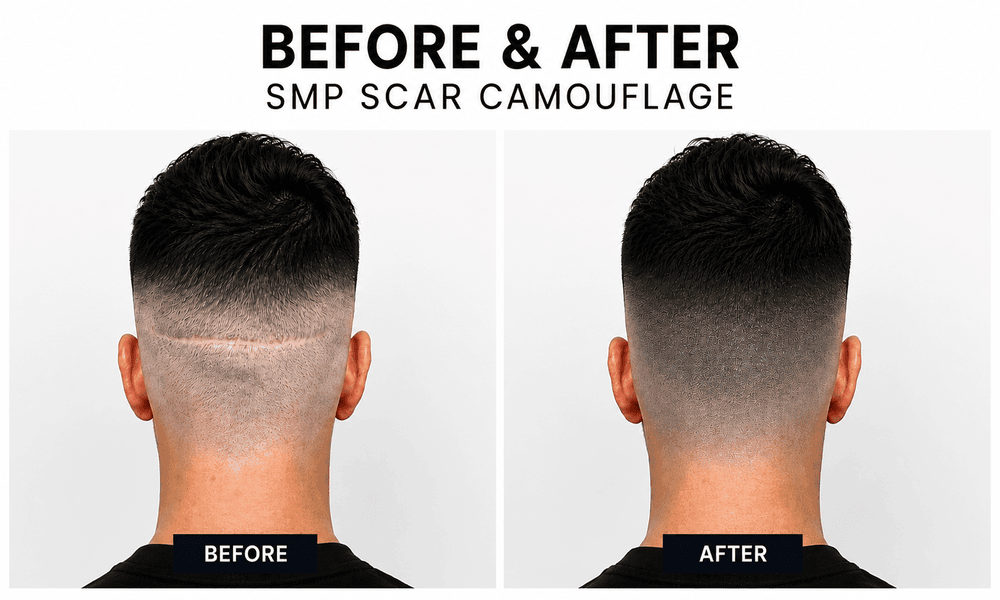
You can see what realistic outcomes look like in our before and after results.
What Should FUT Patients Know About Strip Scar Camouflage?
FUT strip scars respond to SMP, but they require a more gradual process. The linear scar across the lower back of the scalp presents different challenges from scattered dot scars, and that affects both the number of sessions needed and what the final result will look like.
Why the Strip Scar Is a More Demanding Case
A linear scar is typically wider than individual FUE extraction points, and its surface is rarely uniform. Some sections will be flat and healed cleanly. Others may be slightly raised or have a different texture to the surrounding skin. Pigment behaves differently across these variations, which is why building the result gradually matters even more here than in FUE cases.
How Many Sessions Does FUT Scar Work Involve?
FUT scar camouflage usually requires three to four sessions. The additional sessions aren’t about loading in more pigment. They allow the practitioner to assess how the tissue has retained each layer before deciding what to add next.
The same six to twelve month post-surgery wait applies. The scar needs to be fully mature and stable before SMP for hair transplant scar work begins.
What the Result Will Actually Look Like
A wide or raised FUT scar won’t disappear after treatment. What changes is how much it registers. At shorter hair lengths, the scar blends into the pigmentation around it rather than standing out as a pale, hairless band. At longer lengths, the hair above naturally helps coverage along.
Most clients find the outcome removes the practical limits the scar had placed on them — the restricted haircut choices, the reliance on certain styles, the self-consciousness under particular lighting.
Are There Cases Where SMP Won’t Deliver Good Results?
Yes. SMP is not a universal fix for every type of transplant scarring. A few specific conditions make treatment either inadvisable or far less predictable, and any honest practitioner should flag these before booking sessions.
Keloid and Raised Hypertrophic Scars
These are the most common contraindications. Keloid scars grow beyond the original wound boundary and have a dense, irregular collagen structure. Hypertrophic scars are similarly thick but stay within the original scar boundary. In both cases, scar tissue absorbs pigment unevenly. Dots placed into a keloid can migrate, spread, or produce a patchy appearance that draws more attention to the area rather than less.
❗Important: Clients with a known tendency toward keloid formation should discuss this at the consultation before committing to any sessions.
Active Hair Loss in the Donor Area
SMP scar work is only as stable as the skin around it. If hair loss in the donor zone is still progressing, the overall density pattern continues to change after treatment. Pigment applied now may look inconsistent within a year or two as the surrounding follicles thin further. Waiting until the hair loss has stabilised produces a more lasting result.
Extensive Necrosis
Necrosis is the death of scalp tissue, usually caused by blood flow disruption following serious post-surgical infection. Skin in these areas doesn’t hold pigment reliably. Results are unpredictable regardless of the practitioner’s skill level, and no amount of additional sessions changes that.
This outcome is rare. If the affected area is localised, SMP may still be viable in the healthy tissue surrounding it. A consultation will clarify quickly if your specific situation is a workable candidate for treatment.
Not sure if your case is a fit? Find out in 30 minutes
Some scar cases respond well to SMP, others don’t — and the only way to know is an honest assessment. Will Quaye reviews keloid risk, donor area stability, and tissue health before quoting any sessions. Free, no obligation.
How Do You Choose the Right SMP Specialist for Scar Work?
Scar camouflage demands more from a practitioner than a standard SMP hairline or density treatment. The tissue behaves differently, the margin for error is smaller, and the assessment before treatment matters as much as the treatment itself. Who you choose affects the result more here than in almost any other SMP application.
Four Things Worth Checking Before You Book
- Scar-specific case history. Ask to see before and after examples of transplant scar work specifically. General SMP results, even impressive ones, don’t confirm scar competence.
- Clinical scalp knowledge. Understanding how different scar types retain pigment, and how healing affects that retention, requires more than artistic skill alone.
- Honest pre-consultation. A practitioner who tells you what they can’t achieve is one you can trust. Anyone who promises a perfect result at first meeting is worth questioning.
- Staged application. Scar tissue needs a gradual build. A practitioner who pushes for maximum coverage in a single session is skipping the assessment process that scar work requires.
Why Trichology Training Changes Things
A qualified trichologist understands the scalp at a tissue level, not just a visual one. That matters for scar cases because deciding when to proceed, how many sessions to plan, and how much pigment to deposit in a given area isn’t a purely aesthetic call. It draws on an understanding of how the skin has healed and what it can reasonably accept.
This combination of SMP artistry and clinical scalp knowledge is what Will Quaye brings to every case at Scalp Nation. A three-time award-winning practitioner and qualified Clinical Trichologist with over six years of experience, he approaches scar cases with the precision they need.
You can explore the full SMP after hair transplant service to understand what that looks like in practice.
Ready to Find Out What’s Possible?
Visible scarring after a hair transplant doesn’t have to stay visible. Hair transplant scar camouflage offers a non-surgical route forward that works around your existing situation, without another recovery period or surgical commitment.
If you’re ready to find out what’s possible for your specific case, a free consultation with Will Quaye is the natural next step. It takes thirty minutes, costs nothing, and gives you a clear, honest picture of what’s achievable. Book your free consultation.
FAQ
Can SMP make a hair transplant scar completely invisible?
SMP reduces visual contrast rather than erasing the scar entirely. Most treated scars become far less noticeable, though the texture of the scar itself remains.
When can I start scar camouflage after hair transplant surgery?
Most practitioners recommend waiting six to twelve months post-surgery before starting hair transplant scar camouflage. The donor area needs to be fully healed, and any ongoing hair loss in the zone must be settled before treatment begins.
Does SMP on scar tissue hurt more than on a healthy scalp?
Scar tissue can be more sensitive than healthy scalp skin, though most clients find the discomfort manageable. Topical numbing is applied before each session to keep things comfortable throughout.
Can SMP treat scars from older hair transplants?
Yes. Aged scars that have fully matured tend to respond well to treatment, making scar camouflage after hair transplant a reliable option even years down the line. FUT scar camouflage on an older linear scar follows the same assessment as a more recent one, and the long-term stability of the tissue can work in your favour.
Can SMP and a second hair transplant be combined?
They can work together. Some clients use FUE scar cover-up alongside a second transplant to address both density and donor area scarring at the same time. The two treatments need to be timed carefully, with adequate recovery between them.

 By Will Quaye

No comment yet, add your voice below!