
Hair loss pushes most people toward one of two non-surgical solutions: a hair system or scalp micropigmentation. Both conceal the same problem. Neither is universally better.
The right choice depends on how you live, what stage your hair loss has reached, what your budget looks like over time, and whether you’re ready for something permanent. So, in this article, we’ll lay out both options honestly, so you can decide for yourself.
Key Takeaways
- Hair systems and SMP solve the same problem in completely different ways — one is wearable and removable, the other is a permanent change to the scalp itself.
- Hair systems offer styling flexibility and reversibility; SMP offers consistency, zero daily upkeep, and long-term cost efficiency.
- Neither option is objectively better — lifestyle, loss stage, budget, and readiness for permanence all shape the right answer.
- Five specific scenarios favour a hair system, including the desire for length, removability, and mild climates with low physical demand.
- Five specific scenarios favour SMP, including active lifestyles, advanced hair loss, scar camouflage, and long-term cost of ownership.
- A hybrid approach exists — and most people are never told about it.
- The comparison applies to women, too, though female hair loss patterns shift how each solution performs in practice.
- A free consultation is available if you want an honest assessment of which option suits your specific situation.
What Is a Hair System?
A hair system for men (and for women) is a custom-made unit of real or synthetic hair, attached directly to the scalp using adhesive tape, glue, or clips. Think of it as a precision-fitted, wearable solution that sits on top of the scalp rather than altering it. Quality units can be cut, coloured, and styled like natural hair, including worn at length.
Hair systems come in several base types:
- Lace front — lightweight and breathable, with a natural-looking hairline.
- Skin base — thin polyurethane that bonds closely to the scalp.
- Monofilament — durable mid-range option with good ventilation.
The defining characteristic of any hair system is that it requires ongoing commitment. Units need reattaching every one to two weeks and replacing every three to six months. Adhesives, specialist cleaners, and colour matching are all part of the routine.
Day one in a quality system can look impressive, but what follows is a long-term relationship with maintenance that catches many people off guard.
What Is Scalp Micropigmentation?
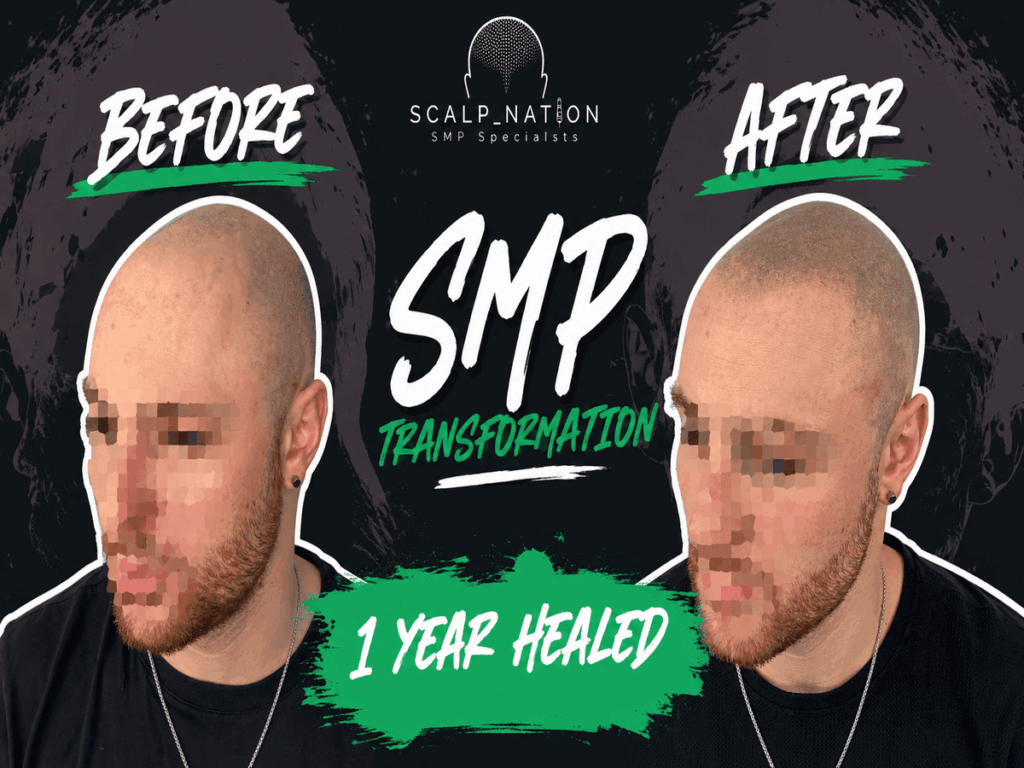
Scalp micropigmentation is a non-surgical cosmetic procedure that deposits tiny dots of pigment into the upper layers of the scalp, replicating the look of closely cropped hair follicles. No hair grows. The result is a precise, consistent visual impression of a shaved or buzz-cut head.
Most clients complete three sessions spaced roughly two weeks apart. Each session builds on the last, gradually increasing density and refining the hairline. Results are visible almost immediately after the first appointment.
The pigment is long-lasting but not indefinite. Natural fading develops over several years, at which point a single touch-up session restores the appearance. It won’t vanish on its own without laser removal.
SMP works best when the head is kept closely shaved. The pigmented dots and natural stubble blend together to create the effect. Worn at length, that illusion breaks down.
SMP vs Hair Systems: Side-by-Side
On paper, both options address hair loss. In practice, they ask completely different things from you — different budgets, different routines, different lifestyles, and different levels of commitment. So, we created a table below that covers the factors that tend to drive the final decision.
| Factor | Hair System | SMP |
| Hair length | Any length or style | Shaved/buzz-cut for full baldness (existing hair of any length for density work) |
| Daily upkeep | High — adhesives, cleaning, styling | Minimal — regular shaving only |
| Reattachment frequency | Every 1–2 weeks | Not applicable |
| Unit or touch-up lifespan | Unit replaced every 3–6 months | Touch-up every 3–5 years |
| Water and sweat resistance | Adhesive weakens with moisture and heat | Fully resistant once healed |
| Upfront cost (UK) | £300–£1,500+ per unit | £2,450–£3,000 typical |
| Estimated 5-year total cost | £3,000–£6,000+ | £2,450–£3,500 incl. one touch-up |
| Appearance day to day | Can vary with wear, humidity, and colour fade | Identical every single day |
| Scar coverage | Sits above the scalp, does not blend scar tissue | Specialist technique blends directly into the scalp |
| Reversibility | Fully reversible — stop at any point | Requires laser removal to reverse |
| Suitable for women | Yes — wigs, integration systems, full units | Yes |
| Pain or recovery | None | Mild redness for 24–72 hours per session |
| Sun sensitivity | Low | UV exposure accelerates fading — sunscreen recommended |
| Activity restrictions | Avoid prolonged water exposure and heavy sweating | Avoid sweating for 4 days (after procedure), swimming for 28 days post-session. After that, everything is allowed. |
When Is a Hair System the Better Choice?
1. You want to wear your hair at length
SMP works with existing hair to add density, but on a fully bald scalp, the effect only reads convincingly at very short lengths. If your goal is styled, longer hair — a fringe, a parting, a cut you can run your hands through — a hair system is the only non-surgical route that delivers it. For many people, this single factor settles the decision entirely.
2. You’re not ready for a permanent commitment
A hair system asks nothing permanent of you. Stop wearing it, and nothing has changed. SMP fades gradually but doesn’t disappear without laser removal. If you’re still working through the emotional side of hair loss and want to keep your options fully open, a system gives you that breathing room.
3. You have a medical contraindication for SMP
Certain scalp conditions, a history of keloid scarring, or active skin disorders can make SMP inadvisable. A qualified trichologist can assess this during a consultation, but it’s worth knowing in advance that SMP isn’t appropriate for every scalp.
4. Your climate and lifestyle are adhesive-friendly
Adhesive performance suffers in sustained heat and humidity. If your daily life is largely office-based, your climate is mild, and intense physical activity is occasional rather than routine, the practical gap between a system and SMP narrows considerably.
5. You need the option to remove it
Some people want a solution they can take off — for privacy, intimacy, or personal preference. A hair system comes off when you choose. SMP does not. For anyone who values that control, a system has an advantage no other non-surgical option can replicate.
When Is SMP the Better Choice?
Five situations where SMP consistently outperforms a hair system.
1. Daily maintenance has worn you down
Long-term hair system wearers often describe a slow shift in how the system feels. What started as relief gradually becomes a schedule — reattachment appointments, adhesive application, colour matching as natural hair greys. SMP removes that cycle entirely. Once healed, there is no routine beyond shaving.
2. Your lifestyle involves sport, swimming, or physical work
Sweat and prolonged water exposure degrade adhesive bonds. For competitive swimmers, regular gym-goers, manual workers, or anyone whose daily life doesn’t pause for maintenance windows, SMP is structurally more practical. It doesn’t lift, shift, or react to saltwater. After the initial healing period, there are no activity restrictions at all.
3. Your hair loss is at Norwood 5, 6, or 7
At advanced stages, the area needing coverage expands significantly. Understanding where you sit on the Norwood scale puts that into context. Higher classifications mean a hair system must cover most of the scalp, which increases cost, complexity, and the frequency of reattachment. SMP scales to any level of loss without those compounding demands.
4. You have transplant or injury scars to camouflage
SMP deposits pigment directly into scar tissue, blending it with the surrounding scalp. A hair system sits above the scalp and does nothing to address scarring underneath. For anyone with FUT strip scars, FUE puncture scars, or injury-related scarring, SMP offers scar camouflage, a targeted solution that no hairpiece can replicate.
5. The 10-year cost of ownership is a deciding factor
The upfront cost of SMP is higher than a single unit. Over a decade, the picture shifts. Unit replacements, adhesives, specialist products, and reattachment appointments can reach two to four times the lifetime cost of SMP with one touch-up included. For anyone thinking long-term, the numbers favour SMP clearly.
Can You Actually Use Both?
Few people know this is an option. Fewer still realise how practical it can be.
SMP and hair systems are not mutually exclusive.
Some clients choose to have SMP completed first, then continue wearing a hair system over it during the adjustment period. The SMP provides a natural-looking base for moments when the system comes off — swimming, intimacy, or simply testing life without it. It removes the all-or-nothing pressure that puts many people off SMP in the first place.
A second approach works differently. Some people maintain a hair system for specific occasions where length or styling is preferred, while using SMP as their everyday baseline. The result is flexibility without vulnerability — a consistent, presentable appearance regardless of whether the system is worn that day.
What to consider before going hybrid
- Pigment shade needs to be matched carefully to the hair system colour.
- A practitioner who understands both solutions will give more accurate guidance than one who specialises in only one.
- The approach works best when planned from the start rather than added as an afterthought.
This combination rarely appears in standard consultations. If it sounds relevant to your situation, it is worth raising directly when you speak to a specialist.
Does This Apply Differently for Women?
The core comparison holds, but the context shifts. Female hair loss more commonly presents as diffuse thinning across the scalp rather than a receding hairline, which changes how each solution performs.
Hair systems for women range from full wigs to partial integration units that blend with existing hair. They offer styling flexibility and immediate coverage, particularly useful when loss is sudden or uneven.
SMP for women typically focuses on density enhancement rather than the full shaved-head aesthetic seen in male treatments. It works well for widening parts, thinning crowns, and hairline definition — areas where a hair system can feel excessive relative to the problem.
The same five scenarios from both earlier sections apply. The question is still about lifestyle, loss pattern, and how much daily involvement feels acceptable.
Still Unsure Which Direction to Take?
Both options have genuine merit. The right one depends on details that are difficult to assess without looking at your specific scalp, hair loss pattern, and lifestyle.
At Scalp Nation, free consultations are available in person or via video call. If a hair system suits your situation better, that is what we will tell you. Book a free consultation and get an honest answer.
FAQ
Can SMP look unnatural if done incorrectly?
Yes. Pigment placed too deep, too dark, or with poor hairline design can produce an unconvincing result. Choosing a qualified, experienced practitioner is the single most important decision in the process.
Does wearing a hair system long-term affect the scalp underneath?
Prolonged adhesive use can cause irritation and sensitivity. Regular scalp care and choosing gentler attachment methods reduce the risk considerably.
Can I get SMP if I still have some hair?
Yes. SMP works well alongside existing hair to add the appearance of density. You do not need to be fully bald for the treatment to be effective.
How do I know which Norwood stage I am at?
A trichologist or trained SMP practitioner can assess this during a consultation. The Norwood scale is also a useful reference for understanding where your hair loss currently sits.
Is SMP a good option for women with thinning hair rather than full baldness?
Yes. For diffuse thinning, widening parts, or hairline definition, SMP can be highly effective without requiring a shaved head.


 By Will Quaye

No comment yet, add your voice below!