
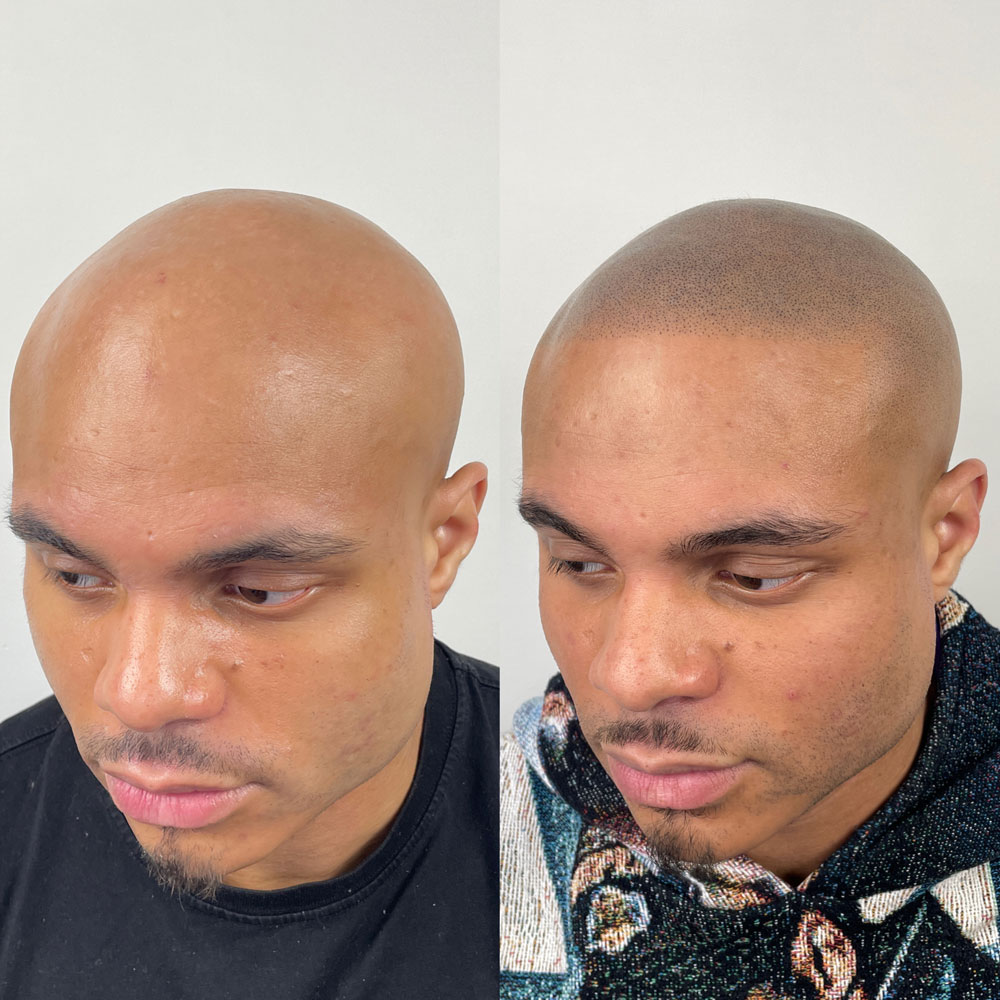
Thousands of follicle-sized pigment dots, set across bare patches or an entirely hairless scalp, can recreate the look of a fresh close shave, and that is the whole purpose of an alopecia tattoo. None of the pigment reaches the immune activity behind alopecia areata. It changes how the scalp looks and leaves the condition itself untouched.
Planning a head tattoo for alopecia takes more thought than the same treatment for pattern baldness, because patches can open, close and wander, and medication can bring hair back for a time, which makes the booking date as important a decision as the design itself.
What you’ll learn in this guide
- Why total scalp hair loss calls for a hairline designed without any natural reference
- How a trichologist tells a quiet patch from an active one before pigment goes in
- What NHS access to JAK inhibitors means for the order of treatment
- What happens to patch-only coverage when a new patch appears elsewhere
- What one dermatology team reported after a full-scalp tattoo in alopecia universalis
Why Does an Alopecia Tattoo Need a Hairline Designed From Scratch?
Most people with alopecia totalis or universalis have no receding pattern and no surviving hairline to follow. Their front edge has to be designed from facial structure and the client’s own preferences.
Pattern baldness usually leaves a horseshoe of hair at the sides and back, which shows the artist where the hairline once was. A fully bare scalp removes that reference, and a hairline placed too low or cut too sharply becomes the detail that gives the tattoo away. Will Quaye favours soft, irregular edges for exactly that reason, and clients set on a razor-sharp barber finish are usually better served by another artist.
Shade is chosen with the same caution, and the first session of a head tattoo for hair loss at Scalp Nation uses a lighter tone that is reviewed at the second visit once it has healed.
Why Do Some People With Alopecia Choose a Decorative Bald Head Tattoo?
Some people with total scalp hair loss prefer visible artwork to imitation stubble, because a design needs no believable hairline and makes no attempt to pass as hair.
Search results for a bald head tattoo mix that kind of artwork with follicle work, yet follicle work differs from a traditional tattoo in needle size, pigment and placement depth, with each difference changing how the finished work ages. Regrowth is the less obvious risk for anyone with alopecia areata, since returning hair can bury a design that was meant to be seen.
| Decorative head tattoo | Follicle-replica tattoo | |
|---|---|---|
| Goal | Visible artwork | The look of a close shave that goes unnoticed |
| Ink placement | Deeper, with solid lines and fills | Upper dermis, as individual dots |
| How it ages | Lines hold, colours may soften | Softens gradually and needs occasional top-ups |
Which Forms of Alopecia Need Medical Clearance Before a Head Tattoo?
Patchy alopecia areata, alopecia totalis and alopecia universalis can all be covered once the condition has gone quiet, but scarring and inflammatory forms need a dermatologist’s view before any pigment touches the skin.
- Patchy alopecia areata. The most common candidate, and the form where timing needs the closest attention.
- Alopecia totalis and universalis. Full coverage is the usual plan, and with no donor hair left to move, a transplant is off the table, which leaves wigs, hair systems and pigment as the realistic choices.
- Ophiasis. A band of loss around the back and sides of the head needs careful blending into a crown that may still grow hair.
- Scarring alopecias such as lichen planopilaris. Pigment goes in only after a dermatologist confirms the inflammation has burnt out, since scar tissue absorbs pigment differently from healthy skin.
- Traction alopecia. Suitable once the hairstyles causing tension have stopped and regrowth has had time to show.
Telogen effluvium is left off the list on purpose, as that kind of shedding usually recovers once its trigger passes, and each of the forms of alopecia deserves a diagnosis before any cosmetic decision.
How Long Should Alopecia Areata Stay Quiet Before You Book?
The practical test is that patches have stopped spreading and an assessment finds no signs of active disease, since a tattoo can only cover the skin it touches on the day of treatment, and no fixed number of months applies to everyone.
Alopecia areata tends to relapse and remit, and some signs of activity can be seen under magnification that a mirror will not show. Under a dermatoscope, broken “exclamation mark” hairs and black dots mark a patch that is still active, short fine regrowth points to recovery, and yellow dots are more typical of loss that has been present for a long time.
If you are planning a tattoo for alopecia within the next year, photographing each patch monthly in the same light gives the trichologist a dated record of edges that have held or crept outwards.
Should You Try JAK Inhibitors Before an Alopecia Tattoo?
People with severe alopecia areata have good reason to ask a dermatologist about JAK inhibitors first, given that these tablets can bring back real hair and pigment added beforehand is harder to undo than a prescription is to stop. NICE recommended ritlecitinib for NHS use in March 2024 for people aged 12 and over with severe alopecia areata.
Teenagers can start that medication, but the Tattooing of Minors Act 1969 bars tattooing anyone under 18 in Great Britain except for medical reasons by a doctor, and Northern Ireland has an equivalent order, so the pigment decision waits until adulthood. Visible improvement on these tablets usually appears within three to four months, and some people reach full regrowth only after nine to twelve months. In the two BRAVE-AA trials behind baricitinib’s approval, fewer than 40% of people on the higher dose reached at least 80% scalp coverage by week 36.
British Association of Dermatologists guidance on ritlecitinib tells patients to expect regrown hair to fall out again if they stop taking it, which is why some people keep pigment in reserve as a fallback and others book an alopecia tattoo alongside medication. Anyone already taking a JAK inhibitor should mention it at consultation and check with their prescribing doctor first, since these drugs dampen parts of the immune system.
What Happens to Patch-Only Coverage When a New Patch Appears?
A new patch that opens outside the tattooed zone stays bare, and its contrast with pigmented skin nearby can draw more attention than the original loss did. That risk is the reason coverage plans hinge on how predictable the condition has been.
Full-scalp coverage raises the treatment costs at the outset, yet it makes a head tattoo for alopecia a finished look that no longer depends on where the next patch decides to appear, which is why it tends to suit totalis, universalis and patches that keep moving.
Patch-only work suits alopecia confined to one or two spots that have not changed for a long time, and the hair around them is usually kept short, because Scalp Nation advises that working through longer hair can compromise the result.
Anyone who would not consider a shaved head can still have pigment placed through longer hair, worked section by section as in Scalp Nation’s treatment for women, with the aim of lowering the contrast between bare scalp and the surrounding hair.

Can Hair Grow Back Through an Alopecia Hair Tattoo?
Hair can grow back through the pigment, as the dots go into the upper skin and the root that produces each hair lies deeper down. Scalp Nation’s own guidance is that the treatment does not damage existing hair, and on a shaved head, regrown stubble adds density to the dots.
If regrowth comes back white
Hair returning after an alopecia areata flare can come through white at first, leaving pale stubble next to darker dots. Pigmented hair can return in later growth cycles, and if the white regrowth persists, the shade of the dots can be reviewed at a top-up.
If you want to grow your hair out
Longer hair hides the dots completely, provided the tattooed hairline was never placed further forward than your natural one would have been, so anyone still hoping for regrowth should say so before the hairline is drawn.
What Does Recovery Look Like After Each Alopecia Tattoo Session?
Recovery follows the same pattern after every session, and most clients see a clear change after the first appointment, with the biggest difference showing after the second. Each visit lasts two to four hours, with discomfort usually rated between 2 and 5 out of 10 and breaks available whenever needed.
- First 24 hours. Redness and soreness fade within 6 to 24 hours for most people, lingering for up to 72 hours in some cases, and no products go on the skin during the first window.
- First four days. Anything that makes you sweat is off limits, because salt in perspiration can affect how much pigment the skin retains.
- First five days. Shaving the treated scalp waits until day five.
- First 28 days. Gym sessions, running and other strenuous exercise wait until the pigment has healed in.
The second session comes one to two weeks after the first, and the third waits another three to four weeks so the skin can recover fully before final detailing. Gradual fading follows over the years, and a top-up every two to five years brings the shade back up.
What Happens at a Scalp Nation Alopecia Consultation?
Will Quaye leads every consultation, and his diary can run up to three months ahead, so booking early gives the monthly patch photos time to build a useful record before treatment. Results from earlier alopecia clients appear alongside the details of our alopecia hair tattoo treatment.
Will is a Level 4 qualified artist, a clinical trichologist and an associate member of the London Institute of Trichologists, with more than 600 clients treated.
Consultations are free, carry no obligation and run in person at the Hornchurch clinic or by video call, and the timing of a head tattoo for alopecia can be agreed there before anything is scheduled, so book a consultation whenever you are ready to talk it through.
FAQ
How much does an alopecia tattoo cost in the UK?
Scalp Nation quotes alopecia cases individually, with standard full treatments for male pattern hair loss costing £2,450 to £3,000 as a reference point and top-ups starting from £350.
Can the needles from a head tattoo trigger a new alopecia flare?
No clear evidence shows that it does, and the best-known case, published in JAAD Case Reports in 2022, points the other way, describing full scalp regrowth soon after a tattoo in a woman with alopecia universalis. One case cannot predict anyone else's outcome.
Can you speak to someone who has had an alopecia hair tattoo before booking?
Yes, Scalp Nation can put you in touch with previous clients, and you can ask to speak with one who has alopecia.
Can pigment from an alopecia tattoo be removed later?
Yes, laser treatment can remove it over several sessions, and Scalp Nation offers removal, including for work done at other clinics.


 By Will Quaye

No comment yet, add your voice below!