
Diffuse thinning is an even loss of hair density across the top of the scalp, or across the whole head, with no bald patch and no clear pattern. The hair looks flatter, the scalp shows through more easily, and the hairline usually stays where it was. In most cases, one of two conditions is responsible, either a temporary episode of hair fall after a trigger or inherited hair loss that continues over time.
The two need different responses, since one settles once its trigger has passed and the other keeps thinning the hair until it is treated, and waiting out the wrong one can cost a year of density.
Key Takeaways
- Around half of the hair density can go before even thinning becomes obvious in the mirror.
- Most cases come from hair fall after a trigger or from inherited hair loss, and the back of the scalp gives the clearest clue to which one you have.
- One condition can expose the other, so some hair never fully recovers after an illness.
- Hair lost after a trigger usually returns within a year, and inherited thinning can be slowed and partly improved.
- A trichologist confirms the cause with a pull test, magnified scalp images and blood tests.
- For thinning that stays, pigment placed between the existing hairs makes the scalp less visible and lets you keep your hair long.
What Is Diffuse Hair Loss?
Diffuse hair loss is the medical term for hair loss spread evenly across the scalp with no defined patch or pattern. Doctors place it in the non-scarring group, which means the follicles stay alive and, depending on the cause, can produce hair again.
A healthy scalp holds around 100,000 hairs, and at any one time about 85 to 90% of them are in the growth phase, called anagen. The rest are mostly in the resting phase, called telogen, before they fall out. Even thinning appears when this balance changes, either because too many follicles enter the resting phase at once or because the follicles produce finer, shorter hairs with each new cycle.
Because the loss is spread across thousands of follicles, around half of the hair density can disappear before the change becomes obvious in the mirror. The early signs include:
- a parting that looks wider under bright or overhead light
- a ponytail that feels thinner, or a hair tie that needs an extra loop
- scalp showing through on the crown when the hair is wet
What Causes Diffuse Thinning?

Two conditions account for most cases, a temporary episode of hair fall after a trigger and genetic hair loss, with a small group of rarer conditions making up the rest.
Can a trigger cause sudden hair loss all over the head?
A physical or emotional trigger can push a large group of follicles into the resting phase at the same time, and those hairs then fall out around two to three months later. This condition is called telogen effluvium, or TE for short.
Common triggers include high fever, surgery, childbirth, crash dieting, low iron stores, thyroid imbalance and starting or stopping certain medicines.
Severe emotional stress, such as a bereavement, can also start a period of heavy shedding, and a clinical review in the Cleveland Clinic Journal of Medicine found weak evidence that ordinary everyday stress is enough to cause it.
Can inherited hair loss look diffuse?
Androgenetic alopecia (AGA) can look completely even, particularly in women and in early-stage men. Here, follicles sensitive to the hormone DHT shrink a little with each growth cycle, a change known as miniaturisation, and the hairs they produce become finer, shorter and lighter in colour.
Which rarer conditions cause even thinning?
- Diffuse alopecia areata. This autoimmune condition can cause rapid thinning across the scalp without the round bald patches it is known for, and doctors frequently mistake it for one of the two common causes.
- Scarring alopecias. These inflammatory conditions destroy follicles permanently. Redness, scaling, itching or tenderness of the scalp are the warning signs.
Both are uncommon, and both are good reasons to have the scalp examined under magnification before any treatment.
Telogen Effluvium vs Androgenetic Alopecia: Which One Is Causing Your Hair to Thin?
TE starts suddenly, thins the whole scalp evenly, and usually resolves without treatment, whereas AGA starts slowly, affects the top of the head more than the back and continues unless it is treated. Seven clinical signs help a specialist separate the two conditions.
| Sign | TE | AGA |
|---|---|---|
| Speed of onset | Sudden, about two to three months after a trigger | Slow, over months and years |
| Distribution on the scalp | Even across the whole head, including the back and sides | Concentrated on the top, crown and front, with the back and sides spared |
| Hairline | Usually unchanged | Men see receding temples, women keep the front hairline and see a wider parting |
| Thickness of each hair | Normal, hairs fall out at full thickness | Hairs grow back finer and shorter with each cycle |
| Reversibility | Recovers once the trigger is resolved (acute form) | Continues over time, can be slowed or stabilised with treatment |
| Usual age of onset | Any age, most frequent in women aged 30 to 60 | Men from the late teens onwards, women most frequently around and after menopause |
| Trichoscopy findings | Few specific signs, similar hair thickness at the front and back | Variation in hair thickness above 20%, more fine vellus hairs and yellow dots, worse at the front than the back |
Distribution gives the most useful single clue, since genetic hair loss spares the back and sides and TE thins them too. Clinicians report that most men who suspect TE turn out to have AGA, so if baldness runs in your family, read about the early signs of androgenetic alopecia before assuming your hair will recover on its own.
Not sure which one it is? Get a professional answer
Will Quaye uses trichoscopy, pull test, and bloodwork guidance to differentiate telogen effluvium from androgenetic alopecia, or spot when both are present. Qualified Clinical Trichologist (Institute of Trichologists). Free 30-minute consultation, in-person or video call. No obligation.
Can Temporary Hair Fall And Genetic Hair Loss Happen At The Same Time?
Both conditions can affect the same person at once, and a bout of TE can make genetic thinning visible for the first time. When a large group of hairs falls out together, the follicles that were already shrinking from AGA may grow back finer than before, so the density never fully returns. This is why hair can recover after an illness or a pregnancy and still look thinner than it did a year earlier.
A related condition, chronic TE, lasts longer than six months and comes in waves. In women in their forties and fifties, it is very hard to tell apart from early female pattern hair loss without a magnified scalp examination.
If heavy shedding has stopped and density still has not improved after six to nine months, a second cause is likely, and a professional assessment is the right next step.
How Can You Tell If Your Hair Is Shedding Or Thinning?
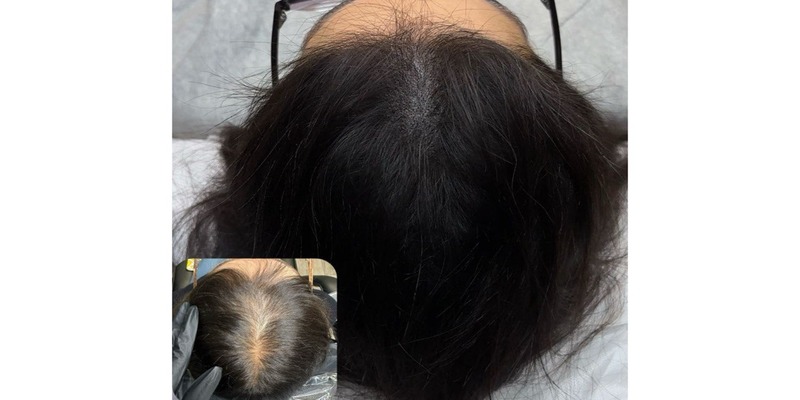
Hair fall describes how many hairs come out each day, and thinning describes what grows back in their place, so you can have one without the other or both at once. Losing around 50 to 100 hairs a day is normal, and clumps in the shower drain or your brush suggest a raised level.
These four checks can help you see which one you are dealing with:
- Look at the root of fallen hairs. A small white bulb at the end means the hair left the follicle from the resting phase, which is the usual pattern after a trigger.
- Compare the fallen hairs with each other. A mix of long, thick hairs and many short, fine ones points towards miniaturisation.
- Part your hair on top and at the back. Under the same light, a clear drop in density on top with full density at the back points towards genetic hair loss.
- Take a photo every month. Use the same angle, lighting and hairstyle each time, because small changes are easy to miss day to day.
A rise in hair fall in late summer and autumn is common and settles within a few weeks, so seasonal shedding on its own is no reason for concern.
These checks point you in the right direction, yet diffuse thinning hair still needs a professional assessment to confirm the cause.
Can Diffuse Thinning Be Reversed?
The answer depends on the cause, as hair fall after a trigger usually recovers fully, and genetic thinning can be slowed and partly improved but not undone.
After an acute episode of TE, hair fall settles within about six months once the trigger has passed. New hair grows at roughly one centimetre a month, so visible density returns slowly over six to twelve months. Chronic TE comes and goes, and correcting low iron stores or a thyroid imbalance helps reduce the episodes.
With AGA, treatment aims to protect the follicles that are still active. Minoxidil, and finasteride for suitable men can stop further loss and thicken hairs that have started to shrink, yet follicles lost years ago will not regrow. Both should be discussed with a GP or prescriber, and neither helps TE, so the diagnosis has to come first.
Diffuse alopecia areata can regrow on its own or with treatment, and its course is hard to predict. Scarring forms cannot recover, so early treatment aims to save the hair that remains.
Who Diagnoses The Cause Of Thinning Hair?
A trichologist or a dermatologist can find the cause of diffuse thinning, and your GP can arrange blood tests when the assessment points to an internal trigger. A full assessment usually follows four steps.
What will the specialist ask about?
The specialist asks about illness, surgery, pregnancy, diet changes, new medicines and stressful events in the two to four months before the hair fall started, along with any family history of hair loss.
How is active hair fall measured?
The specialist uses a pull test, gently pulling small groups of about 60 hairs in several parts of the scalp. If more than six hairs come away from a group, the hair loss is still active.
What happens during trichoscopy?
Trichoscopy uses a handheld magnifying camera to examine the hairs and follicles at the front, top and back of the scalp. It causes no discomfort, and the saved images can be compared at later visits to track density.
When are blood tests or a biopsy needed?
Blood tests through your GP help when the history suggests an internal cause, and the standard panel includes ferritin, full blood count, thyroid function, vitamin D, vitamin B12 and zinc. A scalp biopsy is reserved for unclear cases or suspected scarring alopecia and is carried out by a dermatologist.
At ScalpNation, every consultation is led by Will Quaye, a qualified Clinical Trichologist, so the cause of the thinning is assessed before any treatment is planned.
Full trichology assessment, not just a sales pitch
Will Quaye walks through your history, performs pull test and trichoscopy, and advises which blood tests to request from your GP. Qualified Clinical Trichologist and multi-award-winning SMP artist. Free consultation, in-person or video call. No obligation.
What Can You Do About Thinning That Does Not Grow Back?
Once the cause is confirmed and medical treatment has done what it can, the remaining gap is cosmetic, and the most suitable option keeps your hair at its current length.
Classic scalp micropigmentation (SMP) recreates the look of a closely shaved head and suits extensive baldness. People with diffuse thinning still have plenty of hair and usually want to keep it long, so the shaved style does not suit them.
SMP for long hair places tiny dots of pigment on the scalp between the existing hairs in the thinning zones. The pigment reduces the contrast between the pale skin and the darker hair, so less scalp shows through, and the hair looks denser.
This treatment suits people with:
- stable genetic thinning on top, in men or women
- chronic thinning that remains after deficiencies have been corrected
- ongoing medical treatment or a past hair transplant, as an addition to these
Anyone in an active phase of hair fall should wait, because density may return without treatment, and scarring alopecias need medical control before pigment is applied.
If diffuse thinning hair is affecting your confidence, you can book a free consultation at our Essex clinic or by video call, where the cause is checked first, and every option is explained honestly.
FAQ
Is diffuse thinning the same as male pattern baldness?
Male pattern baldness is one possible cause of even thinning on top, and in its early stages it can look completely uniform. Over time it usually forms a recognisable pattern, with the temples and crown thinning first, and its stages are graded on the Norwood scale.
Can hair grow back after a sudden episode of hair fall?
Hair usually grows back once the trigger has resolved, because the follicles stay healthy throughout the episode. The first sign of recovery is short, upright new hairs along the parting and the hairline.
How long does thinning hair take to become noticeable?
Genetic thinning builds over several years, so many people first notice it after a haircut exposes the thinner zones. Hair fall after a trigger shows within one to three months.
Can stress alone cause permanent diffuse hair loss?
A single stressful period usually causes temporary diffuse hair loss, and the hair recovers once the stress passes. Stress does not create genetic hair loss, but in people with the tendency, it can make the thinning visible sooner.
Does SMP for long hair still work if the hair keeps thinning?
The pigment stays in place as the hair thins, so the scalp keeps a denser look. Top-up sessions add pigment to new zones as the thinning spreads, and many clients pair SMP with medical treatment.


 By Roman Makarenko

 By Will Quaye
No comment yet, add your voice below!