
Hair loss rarely announces itself with drama. It starts quietly: a slightly wider part, a few extra strands on the pillow, a receding edge that wasn’t there six months ago. For roughly half of all men and women, that slow fade has a name: androgenetic alopecia.
Key Takeaways:
- Androgenetic alopecia is driven by DHT and genetic sensitivity, not poor hygiene or stress alone
- Temple recession in men and a widening part in women are the earliest red flags
- FDA-approved treatments (minoxidil, finasteride) need 4–6 months before visible results appear
- Scalp care (UV protection, gentle handling, nutritional screening) supports any treatment plan
- Early-onset pattern baldness has documented links to cardiovascular and metabolic conditions
- Scalp micropigmentation offers a non-pharmaceutical cosmetic alternative
What Is Androgenetic Alopecia?
If you’ve asked what androgenetic alopecia is, it comes down to a genetically driven form of hair loss triggered by an excessive response to androgens. It sits behind more hair loss cases than any other diagnosis and can begin at any point after puberty.
The condition follows distinct patterns depending on sex. Men typically notice thinning at the temples and the crown of the head first, a progression mapped by the Norwood-Hamilton scale. Women tend to keep their frontal hairline intact but experience diffuse thinning across the top of the scalp, often measured using the Ludwig scale. By age 50, roughly half of Caucasian men show visible signs, and the figure climbs to approximately 80% by age 70. In women, the incidence rises sharply after menopause.
What Causes Androgenetic Alopecia?
Androgenetic alopecia has two interconnected causes: genetics and hormones.
The genetic component is polygenic, meaning multiple genes from both parents contribute. Sons whose fathers experienced balding carry a 5 to 6 times higher relative risk, but maternal inheritance matters just as much, so checking only your father’s hairline tells you half the story.
Dihydrotestosterone (DHT) is the key molecule on the hormonal side. The enzyme 5-alpha-reductase (specifically the Type 2 isoform) converts testosterone into DHT, a compound that binds far more aggressively to androgen receptors in the scalp. People with androgenetic alopecia tend to have:
- Higher levels of DHT production in affected scalp regions
- Greater density of androgen receptors at the follicular level
- Elevated activity of 5-alpha-reductase enzymes
The result is follicular miniaturization. Each hair growth cycle becomes shorter, shrinking the anagen (growth) phase and producing thinner, weaker strands. Over time, follicles can become so small that the hairs they produce fail to break through the skin’s surface. In a healthy scalp, the ratio of growing hairs to resting hairs sits around 12:1; in balding regions, that ratio can collapse to 5:1 or below.
Early Signs of Androgenetic Alopecia
Catching androgenetic alopecia early matters because treatment response tends to be stronger when follicles are still active. Many people only start exploring options, from medication to scalp micropigmentation for alopecia, after the thinning has become hard to miss.
- Gradual temple recession (men): Most men first notice the corners of their forehead becoming more exposed, creating an “M” shape. This frontal-temporal thinning may look minor for months or even years before it becomes obvious to others.
- A widening central part (women): Female pattern hair loss preserves the hairline, so the earliest clue is often a wider part line. If you can see more scalp through the center of your hair than you used to, diffuse thinning has likely started.
- Increased daily shedding: Losing around 100 hairs per day is normal (that’s the exogen phase at work). But if you consistently notice more fallout in the shower drain, on your brush, or across your clothing, a greater proportion of hair may have shifted from anagen into telogen prematurely.
- Miniaturized hairs: A telling clinical marker is the appearance of fine, short, wispy hairs where thick terminal strands used to grow. Dermatologists use dermoscopy to spot these miniaturized follicles, but you can sometimes see the difference yourself in bright lighting.
Any combination of these warrants a dermatological evaluation including dermoscopy and blood work (thyroid function, iron levels, CBC) to confirm the diagnosis and rule out other causes like telogen effluvium or alopecia areata.
Spotting early signs? Get an expert diagnosis
Book a free trichology consultation with Will Quaye — qualified Clinical Trichologist (Institute of Trichologists). Scalp dermoscopy, blood work recommendations, and clear guidance on next steps. Thirty minutes, in-person or video call, no obligation.
Scalp Care Tips for Androgenetic Alopecia
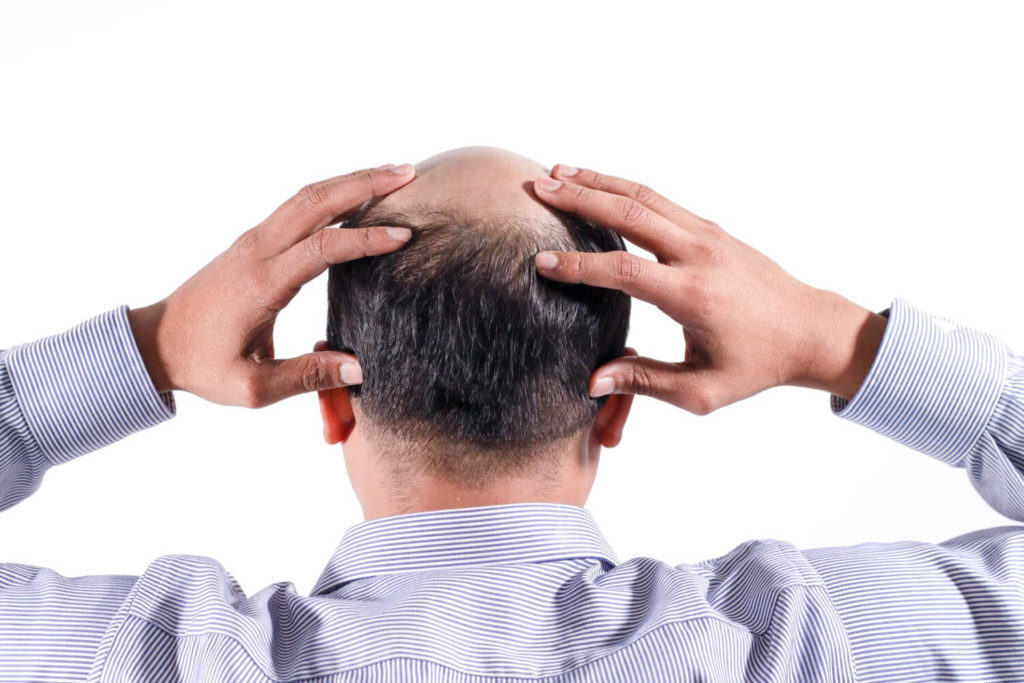
Once you understand the mechanisms behind androgenetic alopecia, protecting the scalp becomes an active priority.
Protect Against UV Damage
As hair thins, more scalp skin gets exposed to ultraviolet radiation. Research links this exposure to a heightened risk of actinic keratosis, a precancerous skin condition. Wearing a hat outdoors or applying a scalp-specific SPF product is one of the simplest protective steps you can take.
Reduce Mechanical Stress
Aggressive brushing, tight hairstyles, and excessive heat styling all place mechanical stress on weakened follicles. Switching to a wide-tooth comb, reducing heat tool usage, and avoiding constant tension helps prevent traction-related loss layered on top of the genetic pattern.
Keep the Scalp Clean but Not Stripped
Sebum buildup and flaking can aggravate an already sensitive scalp. A mild, sulfate-free shampoo used regularly keeps the follicular environment clear without stripping necessary natural oils.
Address Nutritional Gaps
Iron deficiency and thyroid dysfunction have both been associated with accelerated hair shedding. While neither directly causes androgenetic alopecia, they can worsen its visible impact. A blood panel checking ferritin, serum iron, and thyroid hormones can reveal correctable factors that compound genetic loss.
Manage Psychological Stress
Pattern hair loss carries measurable emotional effects, including reduced self-esteem and depressive symptoms. Addressing stress through counseling or peer support won’t slow follicular miniaturization directly, but it can prevent stress-related telogen effluvium from compounding an existing pattern. Some people also find that cosmetic solutions like a hair tattoo solution help restore confidence while they pursue medical routes.
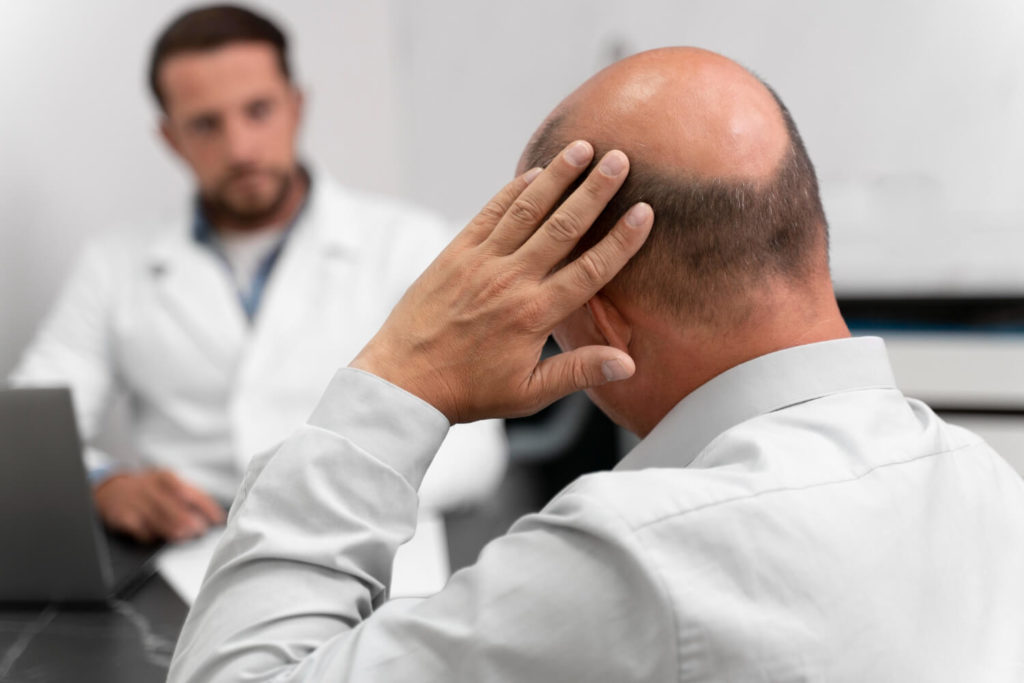
Androgenetic Alopecia Treatment Options
The two FDA-approved medications remain the most widely used androgenetic alopecia treatment tools.
Topical minoxidil (available over the counter at concentrations up to 5%) works as a vasodilator. It widens blood vessels near the follicle, which improves oxygen and nutrient delivery and encourages the anagen growth phase. Common side effects include local irritation and flaking, usually caused by propylene glycol or alcohol in the formulation.
Oral finasteride (1 mg daily) inhibits the Type 2 5-alpha-reductase enzyme, directly reducing DHT conversion. It tends to show stronger results at the vertex than the frontal hairline. Potential side effects include sexual dysfunction that typically resolves over time. Finasteride is contraindicated for women of reproductive potential due to the risk of developmental abnormalities in male fetuses.
Both medications require 4 to 6 months of consistent use before improvements become noticeable, and results only last as long as the treatment continues. Combining minoxidil and finasteride often yields better outcomes than using either alone.
Beyond FDA-approved options, low-level laser therapy at 660 nm has shown effectiveness and is available over the counter. Hair transplantation remains a surgical option for patients with adequate donor density (typically greater than 40 follicular units per cm²). Adjunctive approaches like platelet-rich plasma (PRP) and saw palmetto extract are sometimes used alongside standard protocols but are not standalone therapies.
For women specifically, oral spironolactone acts as an androgen receptor blocker and is frequently prescribed off-label, with fewer than 5% of patients discontinuing due to side effects like menstrual irregularities or hyperkalemia.
When medications and surgery don’t produce the results someone hoped for, cosmetic alternatives fill the gap. SMP for alopecia uses specialized pigment deposits to replicate the look of hair density across thinning zones.
Androgenetic Alopecia and Cardiovascular Risk
Androgenetic alopecia has been linked to several systemic health conditions beyond cosmetic concerns. Research shows a consistent association between early-onset or vertex pattern baldness in men and increased risk of hypertension, myocardial infarction, insulin resistance, and abnormal lipid profiles. In women, the condition has been connected to polycystic ovarian syndrome.
Thinning hair alone won’t predict a cardiac event, but a pattern hair loss diagnosis, especially an early one, gives your primary care physician a reason to screen cardiovascular and metabolic markers more closely.
Discuss your options with a qualified specialist
Will Quaye — qualified Clinical Trichologist and multi-award-winning SMP artist. He’ll assess your pattern, recommend appropriate medical routes, and discuss cosmetic alternatives like SMP. Free 30-minute consultation, in-person or video call.
The Thread That Holds
Androgenetic alopecia never moves backward on its own. Early attention to the signs, consistent scalp care, and an honest look at available treatments for androgenetic alopecia (from minoxidil to scalp micropigmentation) put you ahead of a condition that counts on being ignored. Your scalp is already telling you something; the rest is timing.
FAQ
Is androgenetic alopecia the same as male pattern baldness?
Male pattern baldness is one presentation. Androgenetic alopecia affects both sexes: men lose hair at the temples and vertex, women thin diffusely across the crown.
Can you stop androgenetic alopecia from progressing?
Minoxidil and finasteride can slow progression and sometimes promote regrowth. Results depend on early start and consistent use.
Does washing your hair too often make androgenetic alopecia worse?
No. The condition is driven by hormones and genetics, not hygiene habits.
What is scalp micropigmentation and how does it help with alopecia?
A cosmetic technique that deposits pigment into the scalp to simulate hair density. It won't regrow hair but reduces visible contrast between scalp and remaining strands.
Are there health risks linked to androgenetic alopecia?
Early or vertex-pattern hair loss in men is associated with higher rates of hypertension, insulin resistance, and abnormal lipid profiles. In women, it has been connected to polycystic ovarian syndrome.


 By Will Quaye

No comment yet, add your voice below!