
Grey hair does not rule you out of scalp micropigmentation. The treatment builds the look of shaved stubble through shadow and density, so the colour sitting on top of your head matters far less than most people assume when they first enquire.
What does change with grey and white hair is the margin for error. Pigment sitting close to your own skin tone leaves very little room for a shade chosen carelessly, which is why grey work separates careful practitioners from the rest of the field.
Key Takeaways
- Hair of any colour reads as grey-toned stubble once it is buzzed short, which is what the pigment is matched against.
- Grey work needs diluted pigment and a lighter deposit, not different equipment.
- The technique changes across four scenarios, from a first scattering of grey through to fully white.
- Shade is chosen from your stubble against your skin in daylight, never from the colour your hair used to be.
- No percentage of grey rules the treatment out, though results become softer at one particular combination of hair and skin.
- Going greyer after treatment leaves you two options, and one of them costs nothing.
Does Scalp Micropigmentation Work on Grey Hair?
Yes, because the pigment is matched to how your hair looks once it is cut short, not to how it looks at length. Hair buzzed down to a zero or half guard reads as a grey-toned shadow against the skin, and blonde, mid-brown, black and grey all land in the same tonal family at that length. Scalp micropigmentation copies that shadow with pigment, which is why grey hair rules nobody out.
People asking about SMP for grey hair usually want one of two outcomes. The first is added density between existing grey hairs they intend to keep, where the pigment has to disappear among what is already growing. The second is a clean-shaven look across the whole head, where the pigment carries the result on its own. Closer colour matching decides how well the first one lands, and consistent placement across a wider surface decides the second.
Why Is Grey Hair Harder to Work With Than Dark Hair?
Contrast is what makes grey work demanding, because dark stubble against most skin tones gives a practitioner a wide tolerance where a dot placed slightly too dark still reads as hair. Grey and white stubble is much closer in colour to the scalp underneath, so the same error looks like ink on skin. A flat, bluish cap of dots on an older man is what happens when dark-hair settings are used on someone who needed something lighter.
Three things change when the work is planned around grey.
- Dilution is measured, not judged by eye. Carbon-based pigment is thinned with distilled water in recorded ratios, so the same shade can be reproduced at the next appointment.
- Less pigment goes in per pass. The needle travels to the same depth, but a lighter deposit stops each dot spreading into a heavier mark than intended.
- Fewer layers are built. A dark-haired client might be taken through three full building sessions, where grey work reaches its target tone earlier and stops there.
Not every clinic runs it this way. Applying a standard dark protocol takes less time, and the assumption that fading will soften everything later gets used to excuse the shortcut.
Ask to see healed grey and white cases before you pay a deposit anywhere, and read our guidance on how to choose the right clinic for a hair tattoo if you are weighing up more than one. Good scalp micropigmentation for grey hair comes down to restraint more than anything else.
See healed grey cases before you commit
Will Quaye — multi-award-winning SMP artist and qualified Clinical Trichologist (Institute of Trichologists) — reviews grey and white hair cases individually before quoting. Book a free consultation to see real healed examples matching your hair and skin tone. In-person or video call, no obligation.
How Does the Technique Change for Different Amounts of Grey?
How much grey you have decides both the mix and the placement. Four scenarios come up again and again at consultation, each needing something of its own.
Hair That Is Just Starting to Grey
Your pigment shade is matched to the hair you have now, including the grey. Plenty of people ask for the colour they had at thirty, and the request makes sense emotionally, though it creates a visible mismatch.
The sides and back of the head hold their pigment longest, so a dark crown sitting above salt-and-pepper sides announces itself immediately. Salt-and-pepper stubble also carries two tones at once, so the work uses a mid shade with a scattering of deeper dots to echo what is already there.
Predominantly Grey Hair
A mid-grey base does the bulk of the work here, lifted by a small proportion of darker dots placed at random. Natural stubble never comes in one flat colour, and a field of identical dots looks as printed and not as grown.
That variation is more important on a mostly grey head than on a dark one, where the eye has less contrast to check against.
Fully Grey or White Hair
The lightest dilutions come out for white hair, and your skin undertone starts driving the choice more than your hair does.
Fair skin with a pink cast suits cool ash tones, olive skin takes a softer beige-grey, and darker skin carrying white hair needs muted carbon laid down in thin layers.
Scalp micropigmentation on fully white grey hair leans on the shadow each dot casts across the scalp, so density and spacing carry more of the result than colour alone.
Silver Hair
Silver behaves differently from white because it reflects light. The same head can look pale outdoors and considerably darker under indoor lighting, which makes a single fixed shade unreliable.
Placement gets adjusted alongside tone, usually with slightly tighter dot spacing, so the treated scalp holds its density in bright conditions without going heavy in a dim room.
How Is the Right Shade Chosen?
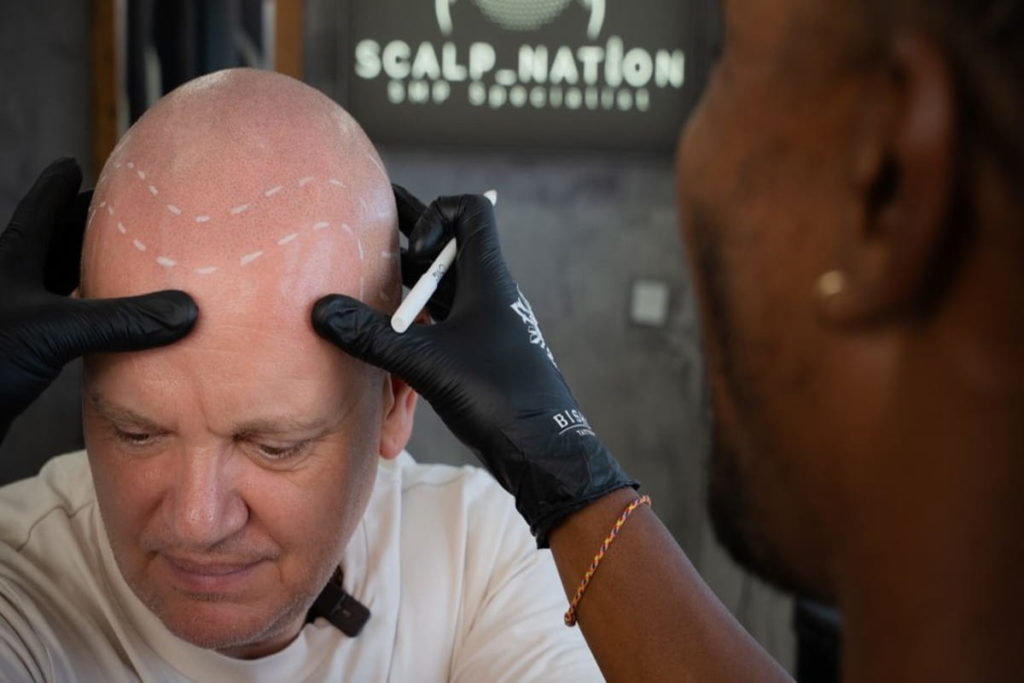
Four checks decide your final shade, and they run in order across the consultation and your first appointment.
- Daylight assessment. Your stubble is compared against your skin outdoors or beside a window, because clinic LEDs flatter and mislead in equal measure, and a shade signed off under them can look several steps too dark once you walk outside.
- A healed test patch. A small patch in a discreet spot is left to heal fully and reviewed before the main work starts, which takes most of the risk out of the decision.
- Light first, deeper later. Pigment can be added at any point and taken out only with difficulty, so the target tone is built across sessions and never reached on the first pass.
- Scalp condition. People going grey are usually people whose scalp has thinned over decades, and older skin holds pigment differently from skin in its twenties, so dryness, healing history and any medication are checked before a final dilution is mixed.
Judging your colour on the day misleads almost everyone, because healed pigment settles lighter than it looks fresh from the needle. Scalp micropigmentation before and after results photographed at the healed stage give a far more honest picture than anything shot in the treatment chair.
A qualified trichologist assessing scalp micropigmentation suitability alongside your grey hair brings the fourth check into the same appointment as the colour choice, which is the part most clinics leave out.
How Grey Can Your Hair Be Before SMP Stops Working?
There is no percentage of grey at which scalp micropigmentation stops working, and neither fully grey hair nor fully white hair counts as a contraindication. What does change with greyness is the strength of the finished effect, and the honest limit comes from how close your pigment sits to your skin and not from the hair itself.
| Skin tone | Hair | What the result looks like |
|---|---|---|
| Medium to dark | Grey or white | Strong definition, clear hairline, closest to a genuine buzz cut |
| Olive or tanned | Salt and pepper | Convincing shaved look with soft edges, minimal compromise |
| Fair with warm undertone | Mostly grey | Good density, gentler contrast, hairline reads softer by design |
| Very fair with pink undertone | White | Subtlest outcome, scalp looks less exposed and thinning reads as fuller, without crisp buzz-cut definition |
The final row in that table deserves a closer look. SMP on grey hair paired with very fair skin still delivers a real improvement, and the promise moves from a sharp shaved head towards a scalp that stops drawing attention. Practitioners who guarantee identical results across every combination in that table are overselling.
What Happens as Your Hair Keeps Greying After Treatment?
Two routes stay open to you, and neither involves starting again. Scalp micropigmentation lightens gradually across the years, so a shade chosen well at forty-five keeps reasonable step with grey hair that carries on losing what colour it has left. Some people let that happen and never return, ending up with a softer scalp tone that suits an older face.
Coming back for a top-up in a lighter dilution than the original is the second route, and it gives you control over timing. Sessions like these tend to be shorter than the original appointments, since they refresh what is already in place without building from a bare scalp.
The claim that fading conveniently keeps step with greying deserves a caveat, though. Fade rate answers to sun exposure, skin type, aftercare and how deeply the pigment went in, none of which follow a schedule tied to your hair.
Two men treated on the same day can sit years apart in how their pigment holds, and our breakdown of why your SMP fades covers the variables in detail. Choosing a shade against skin tone in the first place remains the strongest protection, because pigment matched to skin ages gracefully even when the hair around it moves faster than expected.
Ready to Talk Through Grey Hair SMP?
Grey and white work rewards experience more than almost anything else in this discipline, which is where Will Quaye’s dual qualification earns its keep. As a three-time award-winning Level 4 artist and a qualified Clinical Trichologist, he assesses scalp health and pigment tone in the same appointment, so decisions about dilution rest on how your skin behaves and not on a house standard applied to everyone.
Consultations are free and carry no obligation, in person at the Hornchurch clinic or by video call if travelling first makes little sense. Anyone weighing up scalp micropigmentation options for grey hair in London will find the studio around half an hour from the centre and ten minutes on foot from transport links.
Ready to talk through grey hair SMP?
Book a free 30-minute consultation with Will Quaye — multi-award-winning SMP artist and qualified Clinical Trichologist. In-person at Hornchurch (10 minutes from London transport) or by video call if travelling first makes little sense. No obligation.
FAQ
How long does the pigment last on grey hair before a top-up?
Most clients get three to five years before a refresh feels worthwhile. Lighter dilutions carry less pigment by design, so very pale shades can soften towards the earlier end of that range. Sun exposure moves the number more than anything else, and daily SPF on the scalp buys you considerable extra time.
How many sessions does grey hair usually take?
Two to three, matching what a dark-haired client would expect, though the individual appointments run shorter because less pigment goes down each time. Spacing between the second and third visit sometimes stretches a little longer, giving the tone time to settle so the final shade is judged on healed skin.
Can the SMP be darkened later if my hair turns whiter?
Adding pigment at a later stage is straightforward, and a top-up can deepen the tone whenever you want it. Hair turning whiter usually calls for the opposite adjustment, so most men in that position ask for a lighter refresh. Both directions are available at any point after healing.
Can SMP that came out too dark on grey hair be corrected?
Yes, through laser lightening delivered in gentle low-energy passes across several visits. Work under two years old responds best, and mild over-darkness sometimes softens on its own within the first few months. Never let anyone correct it by tattooing skin-coloured pigment over the top, since that creates a far harder problem to undo.
Does dyeing my hair affect the SMP?
Dye coats the hair shaft and cannot reach pigment already sitting in the skin, so the treated scalp stays exactly as it is. Colouring your remaining hair darker will make the SMP look lighter by comparison, which is worth raising at consultation if you plan to keep dyeing. Avoid getting dye on the scalp itself during the healing weeks.


 By Will Quaye

No comment yet, add your voice below!