
Darker-skinned individuals often hesitate before pursuing scalp micropigmentation, wondering if the treatment will look natural on their complexion. Questions about technique differences, pigment selection, and finding qualified practitioners create understandable uncertainty. The truth? Scalp micropigmentation for darker skin produces exceptional results when performed correctly. The treatment requires specialized knowledge and adjusted techniques, but darker complexions actually offer distinct advantages for longevity and visual impact. Understanding these differences helps you make confident decisions about restoring your hairline and addressing hair loss concerns that affect your daily confidence.
Key Takeaways
- Darker skin requires larger follicle replications and increased pigment volume to match naturally thicker hair
- Specialized pigment selection with warm undertones creates authentic appearances that avoid color shifting
- SMP typically lasts 3-5+ years on darker skin tones—longer than lighter complexions
- Qualified practitioners adjust machine settings, needle depth, and dot spacing for optimal results
- Sharper, more defined hairlines often complement darker skin tones while slower fading extends treatment longevity
Does Scalp Micropigmentation Actually Work for Darker Skin Tones?
SMP delivers outstanding results across every skin tone. Hair follicles appear larger on darker skin compared to lighter complexions, meaning African, Afro-Caribbean, Asian, Indian, and Middle Eastern individuals need tailored approaches that create advantages rather than limitations.
Larger follicles retain pigment more effectively, translating to longer-lasting results. The treatment remains equally safe and effective—just different in execution. Dark skin smp actually offers better pigment stability and reduced fading compared to lighter tones. The contrast between scalp and pigment creates bold, defined appearances that look incredibly natural when executed properly.
Hair types common among darker-skinned individuals—coily, kinky, or tightly curled—naturally grow in denser patterns that SMP replicates beautifully. When practitioners understand how to work with these characteristics, they create results that fool even close observers. The key lies in finding artists who specialize in diverse skin tones rather than applying one-size-fits-all techniques.
Many clinics now recognize that smp for darker skin demands different equipment settings, pigment formulations, and artistic approaches. This specialization means better outcomes for clients who previously worried about whether the treatment would suit their complexion. Scalp micropigmentation for men has evolved significantly, with techniques now accommodating the full spectrum of skin tones and hair textures.
What Makes the Dark Skin SMP Process Different?
The dark skin smp process demands technical precision beyond standard application methods. Understanding these differences separates practitioners who create stunning results from those who produce disappointing outcomes.
Naturally thicker hair requires larger pigment deposits that mirror actual follicle diameter. Too small creates sparse, unconvincing results. Too large produces a flat, painted appearance instead of dimensional hair stubble. Experienced technicians know exactly how much pigment achieves saturation without overshooting into unnatural territory.
More ink fills larger follicles properly without creating safety concerns—it simply matches your natural hair characteristics. This increased volume doesn’t cause side effects; it’s merely adapting the treatment to your biological reality. Needle penetration depth, insertion angle, and pressure must all adjust to prevent pigment from spreading beneath the skin surface, which creates blurry, merged dots.
Critical dot spacing separates experienced practitioners from amateurs. Improper spacing causes neighboring dots to merge during healing, creating solid patches instead of individual follicles. Skilled artists calculate precise spacing that accounts for how pigment behaves in darker skin tissue during the settling process.
Building depth requires multiple sessions with strategic layering, adding density and dimension gradually. Each pass builds on the previous work. Rushing this process or compressing treatments into fewer sessions compromises the final appearance dramatically.
When practitioners ignore these adjustments, clients end up with flat, unconvincing coverage that screams “cosmetic procedure” rather than natural hair stubble. Merged pigment becomes difficult to correct without extensive laser removal.
How Do You Choose the Right Pigment Shade?
Pigment selection separates amateur work from professional artistry. The wrong shade creates obvious, unnatural results that age poorly over time. Darker pigments with warm undertones complement deeper skin tones, preventing the blue or green color shifts that plague traditional tattoo inks. Carbon-based and iron oxide pigments maintain their intended shade throughout the fading process.
Smart practitioners start lighter than the target color, building gradually to allow adjustments between sessions. Going too dark initially requires laser intervention to correct. Artists anticipate natural fading and account for it in their initial color selection. Your natural hair color and skin undertone both guide the process, with cool undertones pairing differently than warm undertones.
Grayscale pigmentation creates the most natural shadow effect. Shaved hair appears gray regardless of original color—red hair shaved down shows gray stubble, as does black hair. Matching this natural gray scale rather than trying to replicate unshaved hair color produces superior results.
Test patches eliminate guesswork before full treatment. Quality clinics apply small sample areas so you see exactly how the pigment settles into your skin and how the color develops over several days. Traditional tattoo inks don’t belong anywhere near scalp micropigmentation due to unpredictable color changes and faster degradation.
Proper pigment selection becomes even more critical for scar micropigmentation on darker skin, where scar tissue accepts pigment differently than healthy scalp, requiring expert blending to achieve seamless camouflage.
Should You Go Bold or Subtle with Your Hairline?
Hairline design for darker skin often favors sharper, more defined edges. This aesthetic preference stems from both cultural norms and technical realities. Crisp hairlines complement the strong contrast between darker skin and pigment, creating intentional, modern appearances rather than apologetic softness. Many clients appreciate this confident appearance that mirrors contemporary grooming standards.
Your natural hair type influences design decisions significantly. Coily or kinky hair creates dense, defined hairlines when grown out—replicating this through SMP maintains consistency with your hair’s natural behavior. Soft, feathered hairlines that work beautifully on straight, fine hair can look mismatched against naturally textured patterns.
Age considerations matter too. Younger clients typically want that sharp, fresh-cut appearance. Older clients might prefer slightly softer edges that suggest mature hairlines. Neither choice is wrong—personal preference drives the decision.
Popular Hairline Style Preferences:
- Sharp/Defined: Clean edges that mirror fresh haircuts, popular among younger clients
- Modern Fade: Gradual density transition creating contemporary dimension
- Natural/Soft: Subtle irregularity mimicking organic growth patterns
Your practitioner should show examples across this spectrum and discuss which option best suits your facial structure and lifestyle. Beware anyone pushing a single “house style” regardless of your preferences or unique characteristics.
What Should You Expect During Healing and Recovery?
Recovery on darker skin follows similar timelines with specific considerations that affect visible healing stages. Initial redness appears as darker discoloration on deeper skin tones rather than bright red inflammation, typically resolving within 24-72 hours. Some clients experience color changes for up to five days depending on skin sensitivity.
Scabbing occurs during normal healing—don’t pick at these scabs as doing so pulls out pigment and creates patchy results requiring additional touch-ups. Let them fall away naturally over 7-10 days. This patience pays dividends in the final appearance.
True color development takes patience on scalp micropigmentation for darker skin. The final shade won’t appear for several weeks as pigment fully settles beneath the surface. Initial darkness fades to your intended tone as healing completes, which is why starting lighter proves beneficial.
Post-Treatment Care Essentials:
- Days 1-4: Avoid sweating, swimming, and sun exposure; keep scalp dry and clean
- Days 5-10: Gentle washing allowed; scabs fall naturally without interference
- Weeks 2-4: Continue sun protection; avoid heavy exercise that causes sweating
- Weeks 4-6: Full healing achieved; final color visible and ready for assessment
Keloid scarring risk exists for individuals predisposed to this condition, particularly those of African and Asian descent. Reputable clinics screen for this history during consultation. If you’ve developed keloids from previous injuries or piercings, discuss this upfront.
Sun protection becomes non-negotiable. UV exposure fades pigment prematurely, though darker skin’s natural melanin provides some protection. Sunscreen or hats preserve your investment and extend longevity.
How Long Will Your SMP Last on Darker Skin?
Smp for darker skin typically outlasts results on lighter complexions. Expect 3-5+ years before needing significant touch-ups, compared to 2-4 years for fairer skin.
Darker skin retains pigment more tenaciously. Larger follicle impressions contain more ink, providing greater volume that fades slowly. Melanin-rich skin offers natural UV protection that preserves pigment integrity.
Fading occurs gradually over years rather than suddenly. Touch-ups every few years restore vibrancy and adjust for any natural hair loss progression. Maintenance requirements remain minimal—no daily applications or system replacements needed.
Sun exposure affects longevity, though darker skin tolerates UV better. Regular sunscreen or hat-wearing extends time between touch-ups. Cost-effectiveness improves with longer-lasting results, reducing total lifetime expenditure.
Get a free, no obligation consultation
Click below to book your free consultation today, and take the first step toward a stronger, fresher, happier you.
What Makes a Practitioner Qualified to Work with Darker Skin?
Red flag: any technician claiming “the process is exactly the same for everyone.” This reveals fundamental ignorance about how skin type affects technique.
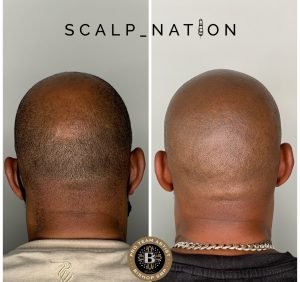
Portfolio examination tells the truth. Request before-and-after photos of clients with similar skin tones. Study the hairline sharpness, dot consistency, and overall naturalness for signs of merged pigment or flat, painted appearances.
Essential Questions During Consultation:
- How many clients with my skin tone have you treated?
- What specific adjustments do you make for darker skin?
- Can I speak with previous clients who have similar complexions?
- What pigments do you use, and why are they appropriate for my skin?
Understanding of coily, kinky, and tightly curled hair types separates good practitioners from great ones. Trichology knowledge provides added confidence—clinical trichologists understand scalp health and how skin responds to treatments. Scalp Nation’s Will Quaye combines award-winning SMP artistry with clinical trichology qualifications, providing the dual expertise that produces exceptional results.
Can SMP Fix Previous Bad Work on Darker Skin?
Poor technique becomes obvious quickly on darker skin. Merged dots, incorrect pigment colors, and unnatural hairlines stand out prominently, but correction work shows improvement more dramatically.
Laser removal remains the primary solution for severely botched SMP. Modern picosecond lasers like PicoWay work safely on darker skin tones, using pressure waves rather than heat to reduce hyperpigmentation risk. Complete removal typically requires 4-8 treatments spaced several weeks apart.
Correction without full removal becomes possible when the original work isn’t catastrophically bad. Skilled practitioners can add strategic dots to improve spacing or blend problematic areas, saving time and money compared to complete removal.
Timeline expectations: full removal and re-treatment takes 6-12 months minimum. Patience becomes necessary when fixing previous mistakes.
Ready to Explore Your Options?
Scalp micropigmentation for darker skin creates remarkable transformations when performed by qualified practitioners who understand the technical nuances. Your skin tone provides advantages—better retention, longer-lasting results, and striking contrast that looks incredibly natural with proper technique.
The key lies in finding an artist with demonstrable experience across diverse skin tones. Don’t settle for generic approaches that ignore how your unique characteristics demand specialized methods.
Scalp Nation’s expertise in working with all skin types, combined with Will Quaye’s clinical trichology background, ensures you receive treatment tailored to your specific needs. See real examples, discuss your concerns, and get honest assessments during a free consultation.
Book your free consultation today to discover how scalp micropigmentation can restore your confidence with results that look authentically you.
FAQ
Why do I need a practitioner with specific dark skin experience?
Darker skin requires adjusted follicle sizes, increased pigment volume, and precise dot spacing to prevent merging—mistakes that practitioners without specialized experience often make, creating visible problems that cost significantly more to correct.
Can I get SMP if I have very coily or textured hair that I want to keep?
Yes, SMP works beautifully for density enhancement through existing hair by applying pigment between your natural follicles to create fuller coverage without requiring a shaved head.
Will my SMP turn blue or green on my darker skin?
Quality SMP pigments don’t change color when applied properly—blue or green tints only occur when practitioners use traditional tattoo inks or place pigment too deep in the skin.
Is there a higher risk of scarring or keloids with SMP on darker skin?
While certain ethnicities show higher keloid predisposition, SMP creates minimal trauma making keloid risk relatively low. Quality clinics screen for keloid history during consultation and adjust treatment plans accordingly.

 By Will Quaye
No comment yet, add your voice below!