
Before-and-after photos pull more attention than anything else in scalp micropigmentation, and they get misread more than anything else, too. People scroll through galleries, land on one striking image, and quietly assume that’s what walking out of a single appointment looks like. It almost never is. A scalp micropigmentation before and after is the compressed sum of several sessions, days of healing, and weeks of the pigment settling into its true shade.
You’ll learn:
- What a single before-and-after photo leaves out, and why that matters before you book
- What decides how dramatic your own result will look
- How the finished look gets built across three sessions, and why the spacing isn’t even
- How to read your own heal week by week and tell normal settling from a genuine fault
- Why your result keeps changing for months after you walk out, and what that means long term
One Photo, Weeks of Work Behind It
A before-and-after image is a summary, not a snapshot of one moment. Two frames sit side by side, and your eye fills in a clear cause-and-effect. Bald on the left, full on the right, done. The work that closed that gap stays invisible.
What got edited out is most of the story. The single hair micropigmentation before and after you’re looking at usually represents three appointments booked weeks apart, plus the healing that happens between each one. The “after” frame is shot once everything has calmed down and the colour has found its level, sometimes a month or more past the final session.
That gap matters for anyone weighing up the treatment. Judge it by the endpoint alone, and the early days can feel alarming, because the fresh scalp looks nothing like the polished photo that sold you on the idea. Learning to see the stages behind the image keeps expectations honest.
If you want the raw proof over the explanation, our transformations gallery holds the real client photo sets. This article is here to explain what you’re actually looking at.
How Does Hair Loss Type Affect the Visible Result?
How big the visible change looks comes down almost entirely to the starting canvas. Two clients can both get excellent work, and one before-and-after will still land far more dramatically than the other, purely because of where each man began.
Take a fully bald crown. Going from that to a dense, cropped look is the most eye-catching jump there is, which is why bald head micropigmentation dominates the galleries. The contrast is enormous, so the camera loves it. Diffuse thinning gives a quieter change, since the pigment fills between existing hairs without rebuilding an entire scalp.
| Starting point | What the work does | How the before-and-after reads |
|---|---|---|
| Fully bald crown | Rebuilds a dense, cropped hairline from scratch | The most dramatic jump, high contrast |
| Diffuse thinning | Fills pigment between existing hairs for density | Subtle, easy to miss in a photo |
| Transplant scarring | Breaks up the pigment to blend the scar into the surrounding hair | Quiet, judged by how invisible the scar becomes |
| Alopecia patches | Matches coverage to whatever hair remains | Varies with patch size and placement |
Then there are the starting points that change the goal altogether. Scar tissue from a previous transplant needs the pigment broken up to blend a smooth patch into the surrounding density. Alopecia patches call for matching coverage to whatever hair remains around them.
None of this makes a subtle before-and-after a weaker result than a dramatic one, and that’s the part worth holding onto. A refined hairline that frames the face and a rebuilt crown are both strong outcomes. They simply photograph differently. The size of the visible change reflects your starting point, not the quality of the work, and quiet results pass closer inspection precisely because there’s less to give them away.
Get a free, no obligation consultation
Click below to book your free consultation today, and take the first step toward a stronger, fresher, happier you.
The Three-Session Climb to the “After”
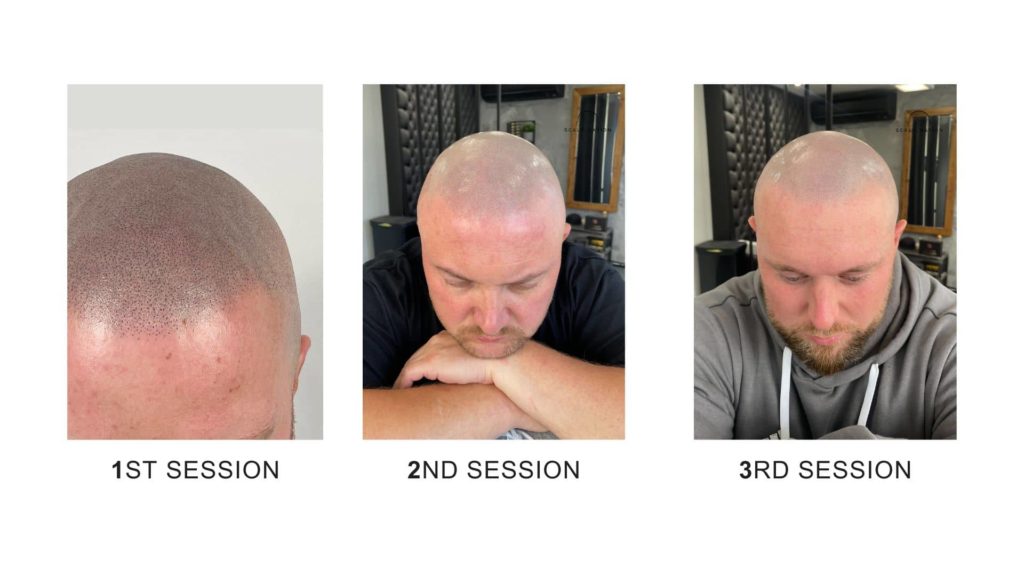
The polished after photo gets built across roughly three sessions, not captured in one. There’s a reason it works this way. An artist could load the scalp with dark pigment on day one, but the result would sit too heavy, heal unpredictably, and leave no room to read how your skin actually holds colour.
Working up in layers solves that. Each visit has a clear job, and the table maps what happens against what you’ll actually see in the mirror.
| Session | What happens | How it looks fresh | What you’ll judge later |
|---|---|---|---|
| First | Hairline mapped, base layer placed | Bold, sharp, darker than expected | How evenly the base settles |
| Second | Density built on healed work | Fuller, still intense | How natural the coverage reads |
| Third | Refinement and final blending | The finished depth appears | The true, settled colour |
Most people notice a real difference after session one and see the biggest leap after session two.
The spacing between visits isn’t padding, and it isn’t even. Your first two sessions sit close together, around one to two weeks apart, which stacks early density quickly during the period your skin is still receptive. The gap before the third stretches longer, closer to three or four weeks, giving the scalp time to fully settle so the artist judges the final detailing against healed colour, not fresh pigment. That widening gap is the reason the day-one look differs so much from the finished one, a change worth grasping before you panic at your own reflection. We cover that swing in detail in our guide to fresh SMP versus healed SMP.
Is Your SMP Healing Normally?
Most disappointment with SMP comes from misreading a perfectly normal heal as a failure. The early scalp behaves in ways that look wrong if nobody has warned you, so learning to read your own heal saves a lot of needless worry.
How a Healthy Heal Looks Week by Week
What you brace for first is darkness. Straight after a session, the pigment sits high in the skin and scabs form on top of each dot, so the scalp reads bolder and rougher than the final result ever will. That early intensity is depth and healing, not a sign the artist went too heavy. Here’s the path a normal heal follows:
- Days 1 to 3: bold, dark dots with mild redness, the harshest the work will ever look
- Days 7 to 10: tiny scabs over each dot shed, taking surface pigment with them and leaving the colour lighter
- Weeks 2 to 3: the shade drops into its true depth and softens toward natural stubble
- Weeks 3 to 4: the surface is smooth, even, and settled; this is your real result
A healthy heal lightens uniformly across the treated zone the whole way through, holding a consistent, realistic density without going patchy.
Signs Worth Flagging to Your Artist
All of this turns a good hair pigmentation before and after into something you read, not just admire. Most early oddness is ordinary healing, but a few changes point to a technique or pigment problem and deserve a message to your artist:
- Patchy retention in place of an even, gradual lightening
- A slide toward blue or grey tones, not a softer version of the original shade
- Coverage that fades hard within months, when it should hold for years
Photograph your scalp under the same light every few days. A consistent record makes the difference between normal settling and a genuine fault easy to spot, and gives your artist something concrete to work from.
Why the Result Keeps Moving After Your Last Session
The healed result isn’t frozen the day it’s declared finished. Plenty of before-and-afters get shot at the point where everything looks crisp, and that image becomes the reference. Your scalp keeps moving past it, slowly.
First comes settling. Across roughly the first month, the pigment finishes bedding into the skin and lands on its true shade, which is why most treatments read as complete somewhere around 30 to 45 days from your final session, not on the day you walk out. People see a clear difference far earlier, after the very first session, but that early density and the settled final colour are two separate milestones worth keeping apart in your head.
Then comes the long, slow lightening that every treatment goes through. Over the years, the pigment softens, which is normal for SMP, not a flaw in the original work. A periodic top-up brings the definition back. If you want the mechanics of why this happens and how to slow it, read why your SMP fades.
See the Whole Transformation in Motion
A still image can only show you two points on a curve. Watching a change unfold in motion gives you what a before-and-after photo edits out. The texture, the angles, the way the pigment reads across a whole head and not just one flattering frame. The video below provides a full 360-degree view of the result, as close as you can get to seeing the work in person before you book.
See the Proof and Map Out Your Own
The most useful skill you can bring to any gallery is knowing what a fair comparison looks like. A before shot and a healed after, taken weeks after the final session under matching light, tells you far more than a dramatic side-by-side photographed the day someone left the chair. Hold every result you see, and eventually your own, to that standard.
The best way to judge what SMP could do for you is to look at real, healed results and talk through your own scalp with someone who does this every day. Browse the transformations gallery for genuine client photos, then book a free consultation to map out what your own before-and-after could look like.
FAQ
Do healed photos look different from the ones taken straight after a session?
Yes, noticeably. A photo taken right after a session shows bold, sharp pigment sitting on the surface. A healed photo, shot weeks later, shows the softened, settled colour that blends with the scalp. The healed version is the honest one, which is why reputable galleries lean on it.
If I grow my hair out later, does my before-and-after still hold up?
For density work, yes. SMP placed to thicken thinning hair stays hidden underneath once you grow the hair back, adding the illusion of fullness at the root. A full shaved-look result is designed for short or shaved hair, so growing existing hair long over it won't suit that style the same way.
Are the dramatic before-and-afters online edited or touched up?
Honest clinics don't need to edit them, but the industry isn't free of it. The fairest way to vet a provider is to ask for healed photos in place of fresh-session shots, look for consistent lighting between the before and after, and check video testimonials, where editing is far harder to hide.
Can my skin type change how my before-and-after turns out?
It can. Oily skin tends to soften pigment faster, and very dry skin may flake during healing, which affects how crisp the early result looks. A good artist factors your skin into pigment choice and depth, so your healed outcome lands where it should, regardless of type.

 By Will Quaye

No comment yet, add your voice below!