
Hair loss doesn’t arrive the same way for everyone. Some people notice circular patches appearing overnight. Others watch a gradual thinning spread across months or years. A few experience rapid shedding after illness, surgery, or medication changes.
Each pattern signals a different condition, and getting the right diagnosis early can make the difference between reversible thinning and permanent loss.
In this guide, we will cover every recognised type of alopecia, including what triggers each one and which forms of hair loss respond to treatment.
Key Takeaways
- How 10 clinically recognised types of alopecia differ in cause, pattern, and outlook.
- Which forms are reversible, and which destroy follicles permanently.
- What role genetics, hormones, autoimmunity, and physical stress play in hair loss.
- How specialists diagnose each condition and when speed is important.
- What treatment and cosmetic options exist for each type.
- When a trichologist consultation becomes the right next step.
What Is Alopecia?
Alopecia is the medical term for hair loss. It covers any condition where hair thins, sheds, or stops growing on the scalp or body. Some types are temporary and resolve once the trigger is removed. Others worsen over months or years and can cause permanent follicle damage.
Clinicians split the main types of alopecia into two categories:
Non-scarring (follicles survive and regrowth remains possible):
- Androgenetic alopecia (male and female pattern baldness)
- Alopecia areata, totalis, and universalis
- Telogen effluvium and anagen effluvium
- Traction alopecia
- Diffuse alopecia
Scarring (follicles are destroyed and replaced by scar tissue):
- Cicatricial alopecia
- Frontal fibrosing alopecia
Where your hair loss sits on this spectrum affects how quickly you should act and which alopecia treatment will be effective.
What Are the 10 Types of Alopecia?
Each type of alopecia listed below follows its own pattern, responds to different triggers, and carries a different chance of regrowth. So, let’s get into it.
Androgenetic Alopecia (Male and Female Pattern Baldness)
The most common form of hair loss worldwide, androgenetic alopecia, affects roughly 50% of men by age 50 and a similar proportion of women over their lifetime. It runs in families and follows predictable patterns that differ between the sexes.
In men, hair recedes at the temples first, forming an M-shaped hairline. The crown thins separately, and over time, both areas merge to leave hair only around the sides and back. Women rarely lose their frontal hairline. Thinning concentrates along the central part, widening it until the scalp becomes visible through the hair.
The Norwood Scale maps the stages of male pattern hair loss, giving men a clear picture of where they stand and what to expect.
Symptoms:
- Receding temples and thinning crown in men
- Widening central part and overall volume loss in women
- Miniaturised hairs (finer, shorter, lighter) replacing normal strands
- Slow thinning over years or decades
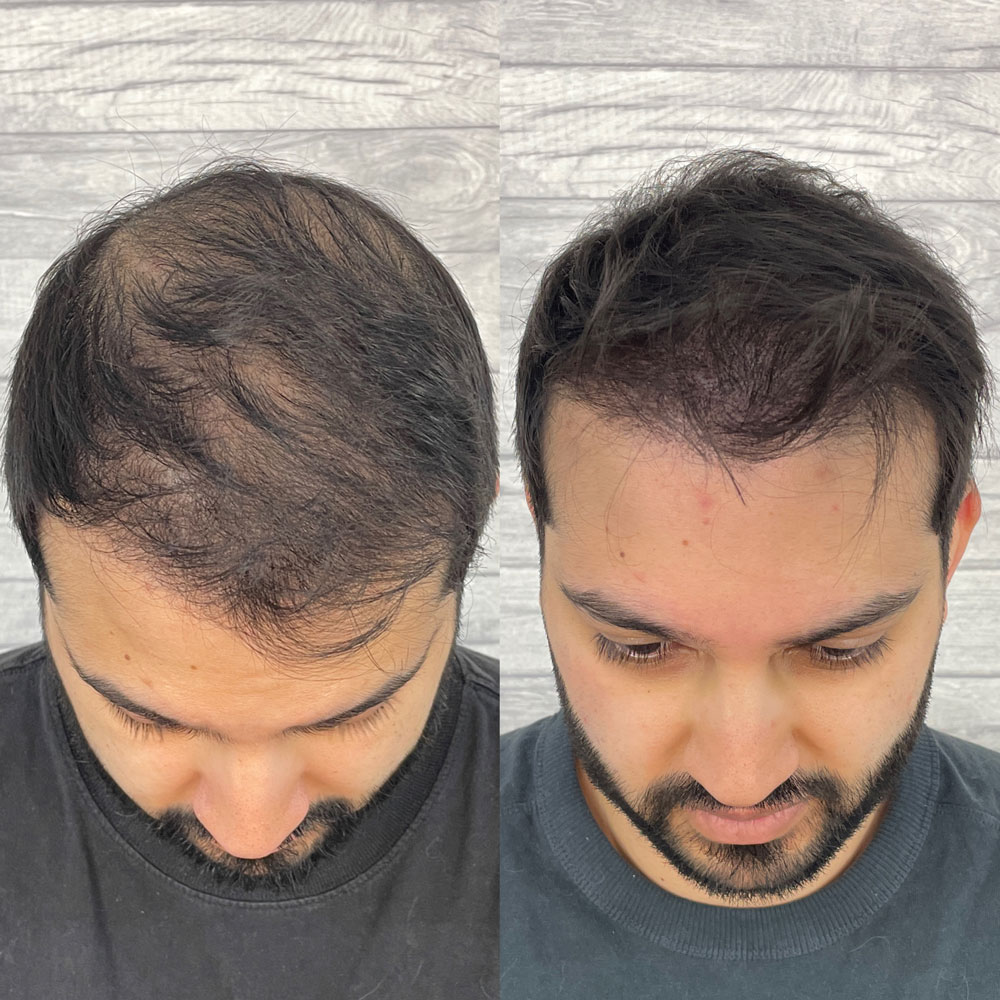
Typical cause: Genetic sensitivity to dihydrotestosterone (DHT), a hormone that shrinks vulnerable follicles with each growth cycle until they stop producing visible hair.
Alopecia Areata
Alopecia areata is an autoimmune condition. The body’s own immune cells target healthy hair follicles, shutting down production in localised patches. It can appear at any age, though the onset before 30 is most common.
Hair falls in smooth, round patches, usually on the scalp but sometimes in the beard, eyebrows, or elsewhere on the body.
The patches show no redness, scaling, or visible scarring. Around the edges, short broken hairs called “exclamation point hairs” (thicker at the top, narrower at the base) are a hallmark sign.
Hair may regrow on its own within months, only to fall again later. This unpredictable cycle of loss and regrowth can continue for years.
Symptoms:
- Sudden, smooth, round bald patches
- Exclamation point hairs at patch borders
- No scarring or inflammation within patches
- Possible nail changes (pitting, ridging)
- Unpredictable cycles of regrowth and further loss

Typical cause: An autoimmune response in which T-lymphocytes (white blood cells) attack healthy hair follicles. Genetic predisposition increases risk, with roughly 20% of those affected having a family history.
Alopecia Totalis
Alopecia totalis is the complete loss of all hair on the scalp. It belongs to the same autoimmune family as alopecia areata but represents a more severe expression. Most cases begin as patchy areata that spreads until no scalp hair remains.
The condition can affect people of any age. Children and young adults receive diagnoses more frequently than older populations. Nail abnormalities (ridging, brittleness, or pitting) accompany the hair loss in a number of cases.
Spontaneous regrowth does occur, but the rate is lower than with patchy areata, and relapse is common.
Symptoms:
- Total absence of hair on the scalp
- Eyebrows and eyelashes may or may not be affected
- Nail pitting or ridging in some individuals
- No scarring or inflammation of the scalp surface

Typical cause: The same autoimmune attack on hair follicles seen in alopecia areata, but wider and more sustained. Both genetic and environmental triggers are believed to contribute.
Alopecia Universalis
Alopecia universalis is the rarest and most extensive form in the autoimmune alopecia group.
Every hair on the body falls out, including scalp hair, eyebrows, eyelashes, nasal hair, and body hair.
Beyond appearance, the loss of nasal hair and eyelashes creates practical health concerns. Nasal hair filters airborne particles, and eyelashes protect the eyes from dust and sweat. People with alopecia universalis report increased eye irritation and a higher frequency of sinus or respiratory discomfort.
Symptoms:
- Complete absence of hair anywhere on the body
- Increased eye sensitivity due to missing eyelashes
- Possible nasal irritation or more frequent upper respiratory issues
- Nail changes similar to other autoimmune alopecia types
Typical cause: A widespread autoimmune response that attacks all hair follicles across the body. Why areata escalates to universalis in some people remains unclear, though genetic predisposition is strongly suspected.
Traction Alopecia
Traction alopecia is caused by repeated physical pulling on the hair. Tight hairstyles, heavy extensions, and chemical treatments that weaken the hair shaft are the primary drivers. It is the most preventable form of hair loss.
The damage builds over time. Early-stage traction alopecia is fully reversible once the source of tension is removed. If pulling continues for years, follicles scar over and that loss becomes permanent.
Certain communities face higher risk due to cultural styling practices involving tight braids, cornrows, or weaves. Men who wear tight buns, topknots, or headgear that grips the hairline can also be affected.
Symptoms:
- Hair loss concentrated along the hairline and temples
- Small bumps, redness, or tenderness around stressed follicles
- Broken hairs and thinning at high-tension points
- Baby hairs along the edges disappearing over time
Typical cause: Sustained mechanical tension from tight hairstyles, heavy extensions, or repeated heat styling. Chemical relaxers compound the damage by weakening hair structure.
Telogen Effluvium
Telogen effluvium causes widespread shedding when a physical or emotional shock forces too many follicles into their resting phase at once. Under normal conditions, around 10% of scalp hairs rest at any given time. During a telogen effluvium episode, that figure can rise above 30%.
What confuses most people is the timing. The trigger (surgery, childbirth, high fever, severe emotional distress, crash dieting) occurs months before the hair starts falling. Shedding usually peaks two to four months after the event.
Most cases resolve on their own once the trigger is addressed. Hair cycles reset over six to twelve months. A chronic form exists, mainly in women, where low-level shedding persists for longer periods without a single identifiable cause.
Symptoms:
- Diffuse thinning across the entire scalp (no patches or bare spots)
- Noticeably more hair in the brush, shower drain, or on pillows
- Frontal hairline remains intact
- Hair feels thinner overall, but rarely leads to complete baldness
Typical cause: A physiological response to a specific stressor such as major surgery, childbirth, severe illness, rapid weight loss, or abrupt hormonal changes. A large number of follicles shift from growth to rest simultaneously.
Anagen Effluvium
Anagen effluvium is rapid hair loss that occurs during the active growth phase of the hair cycle. It differs from telogen effluvium in both speed and severity. Hair falls within days or weeks of exposure to the causative agent, and the shedding can be near-total.
Chemotherapy is the most widely recognised trigger. The drugs target rapidly dividing cells throughout the body, and hair follicle cells, which divide faster than most other cell types, are directly affected. Radiation therapy directed at the head produces similar effects in the treated area.
Hair almost always regrows once the causative treatment ends. Regrowth begins within one to three months and may initially return with a different texture or colour before normalising.
Symptoms:
- Rapid, widespread hair loss (scalp, eyebrows, eyelashes, body hair)
- Onset within days to weeks of starting chemotherapy or radiation
- Hair breaks at the scalp surface or just below it
- Near-complete loss possible depending on drug type and dosage
Typical cause: Cytotoxic drugs (chemotherapy), radiation to the scalp, or exposure to certain toxic chemicals. These agents disrupt cell division within the hair follicle during active growth.
Scarring (Cicatricial) Alopecia
Scarring alopecia is a group of conditions in which inflammation destroys hair follicles and replaces them with scar tissue. Once a follicle is scarred over, hair cannot regrow in that area. The loss is permanent.
Several distinct conditions fall under this heading, including lichen planopilaris, discoid lupus erythematosus, folliculitis decalvans, and central centrifugal cicatricial alopecia. Each has its own triggers and pattern, but all share the same endpoint: irreversible follicle destruction.
Early detection matters more with scarring alopecia than with any other type. Existing damage cannot be reversed, but prompt treatment can halt further spread and protect the follicles that remain.
Symptoms:
- Permanent bald patches with smooth, shiny skin where follicle openings have vanished
- Redness, scaling, or small pustules during active inflammatory episodes
- Burning, itching, or tenderness (often the first sign, appearing before visible hair loss)
- Patches that expand outward without treatment

Typical cause: Inflammatory cells attack and destroy the follicle’s stem cell region. The exact trigger varies by condition: autoimmune dysfunction, bacterial infection, or unknown causes. Genetic predisposition appears to increase susceptibility.
Frontal Fibrosing Alopecia
Frontal fibrosing alopecia (FFA) is a specific subtype of scarring alopecia that targets the frontal hairline. It causes slow, symmetrical recession of the hairline from the forehead backward and frequently involves partial or complete loss of the eyebrows.
FFA predominantly affects post-menopausal women, though diagnoses in younger women and in men have increased in recent years. The condition was first described in 1994 and has become much more commonly recognised since, prompting researchers to investigate environmental triggers alongside the known autoimmune component.
Symptoms:
- Slow recession of the frontal hairline, moving backward symmetrically
- Eyebrow thinning or complete eyebrow loss (frequently one of the earliest signs)
- Loss of eyelashes in some cases
- Pale, slightly scarred skin along the receding hairline
- A visible “lonely hairs” pattern, where isolated strands remain ahead of the main recession line
Typical cause: An autoimmune inflammatory response linked to lichen planopilaris. Hormonal shifts around menopause are believed to play a triggering role, though FFA cases in pre-menopausal women suggest other factors are involved.
Diffuse Alopecia
Diffuse alopecia describes generalised thinning spread evenly across the scalp with no distinct patches, bald spots, or receding lines. It is a presentation pattern, not a single diagnosis, meaning several different conditions can produce it.
What makes diffuse thinning harder to diagnose is that it mimics early androgenetic alopecia in women. Without blood work and specialist examination, the two are easy to confuse. Chronic telogen effluvium, diffuse alopecia areata, thyroid disorders, iron deficiency, and medication side effects can all present as even, widespread thinning.
Symptoms:
- Even, widespread reduction in hair density across the entire scalp
- No defined bald patches, recession pattern, or bare spots
- Scalp visible through the hair, particularly under bright light
- Overall volume loss over months or years
Typical cause: Varies. Diffuse thinning can result from chronic telogen effluvium, diffuse alopecia areata, thyroid imbalance, nutritional deficiency (particularly iron and vitamin D), or prolonged medication use. Pinpointing the underlying cause requires professional assessment.
Comparative Table: All Types at a Glance
| Type | Reversible? | Typical Age | Pattern | Key Trigger |
| Androgenetic alopecia | Treatable, not reversible | 20s onward | Temples and crown (men); central part (women) | DHT and genetics |
| Alopecia areata | Often self-resolving | Any, peak under 30 | Smooth round patches | Autoimmune attack |
| Alopecia totalis | Lower regrowth rate | Any age | Full scalp hair loss | Autoimmune (severe areata) |
| Alopecia universalis | Rarely reverses | Any age | Total body hair loss | Autoimmune (most severe) |
| Traction alopecia | Yes, if caught early | Teens to 40s | Hairline and temples | Mechanical pulling |
| Telogen effluvium | Yes, self-resolving | Any, common 30–60 | Diffuse scalp thinning | Stress, illness, hormonal shifts |
| Anagen effluvium | Yes, after trigger ends | Any age | Rapid, widespread | Chemotherapy, radiation |
| Scarring alopecia | No, permanent | Varies by subtype | Patches with scarred skin | Inflammatory follicle destruction |
| Frontal fibrosing alopecia | No, permanent | Post-menopausal women mainly | Frontal hairline recession | Autoimmune, hormonal |
| Diffuse alopecia | Depends on cause | Any age | Even scalp thinning | Multiple possible causes |
Identified your type? Get an expert assessment
Will Quaye is a qualified clinical trichologist who assesses all 10 forms of alopecia — from autoimmune cases to scarring conditions. Book a free 30-60 minute consultation and find out exactly which type you’re facing and what your realistic options are.
What Causes Alopecia?
Alopecia has no single cause. The trigger depends on the type, and in many cases, multiple causes overlap. Many of these we already covered, but here they’re grouped by category so nothing gets missed.
- Genetic inheritance is the strongest predictor for androgenetic alopecia and increases susceptibility to autoimmune types. The causes of male balding centre on inherited DHT sensitivity passed through family lines.
- Hormonal changes drive male and female pattern baldness through DHT. Pregnancy, menopause, thyroid disorders, and stopping hormonal contraception can all trigger or worsen thinning.
- Autoimmune dysfunction is behind alopecia areata, totalis, and universalis. The immune system attacks healthy follicles, and what sets off this response in specific individuals remains only partially understood.
- Physical and mechanical stress on the hair shaft causes traction alopecia. Tight braids, heavy extensions, and chemical relaxers are the most common causes.
- Emotional and psychological stress can push large numbers of follicles into their resting phase, leading to telogen effluvium weeks or months after the triggering event.
- Nutritional deficiency, particularly low iron, ferritin, zinc, vitamin D, or protein, starves follicles of the materials they need to produce hair.
- Medications and medical treatments, including chemotherapy, radiation, blood thinners, beta-blockers, retinoids, and certain antidepressants can trigger hair loss as a side effect.
- Chronic inflammation from conditions like lichen planopilaris or discoid lupus destroys follicles permanently, producing scarring alopecia.
Two or more of these causes can act at the same time. Someone with a genetic predisposition to pattern baldness may notice faster thinning during periods of high stress or poor nutrition. Accurate diagnosis determines whether the response will be effective.
How Is Alopecia Diagnosed?
Most alopecia diagnoses start with a clinical history and a physical examination of the scalp. In straightforward cases, a specialist can identify the type from the pattern, location, and appearance of the hair loss alone. Less obvious or overlapping presentations need additional testing.
A typical diagnostic workup includes.
Clinical history
When the loss started, how fast it spread, any recent illness, medication changes, or stressful events. Family history of hair loss is also recorded.
Scalp examination
The specialist checks the distribution of thinning, the condition of remaining hair, and the state of the scalp surface (redness, scaling, scarring, or smooth skin where follicle openings have disappeared).
Dermoscopy
A handheld magnification device reveals detail invisible to the naked eye, including follicle openings, miniaturised hairs, broken shafts, exclamation point hairs, and early scarring. This is particularly useful for telling apart types that look similar at a normal viewing distance.
Blood tests
A standard panel checks thyroid function, iron and ferritin levels, vitamin D, zinc, hormonal markers, and autoimmune indicators. These can identify underlying causes that may be driving or worsening the loss.
Scalp biopsy
A small tissue sample is examined under a microscope. This is most valuable when scarring alopecia is suspected, since confirming the specific inflammatory pattern determines the right course of action. Biopsies are not needed in every case.
Not every diagnosis requires all five steps. Pattern baldness in a man with a clear family history may need nothing beyond a visual assessment. Sudden patchy loss with exclamation point hairs points to alopecia areata without further testing.
All of this points toward one question. Are the follicles still alive? That answer separates conditions where regrowth remains possible from those where it does not.
Find out if your follicles are still alive
A trichology consultation answers the question that matters most — whether regrowth is still possible for your specific case. Book a free assessment with Will Quaye (qualified Clinical Trichologist, Institute of Trichologists) including scalp dermoscopy and personalised next steps.
Can Alopecia Be Cured or Treated?
There is no universal cure for alopecia. Some types resolve on their own, some can be managed or slowed with medication, and others cause permanent loss that no drug can reverse. The right alopecia treatment depends on the type, how much hair has been lost, and if the follicles are still functioning.
Medical Treatments
- Minoxidil (topical) stimulates blood flow to follicles and extends the growth phase. Effective for androgenetic alopecia and some cases of alopecia areata. Available over the counter.
- Finasteride (oral) blocks the conversion of testosterone to DHT. Prescribed for male pattern baldness. Requires ongoing use to maintain results.
- Corticosteroids (topical, injected, or oral) suppress the immune response attacking follicles. First-line treatment for alopecia areata.
- JAK inhibitors (oral) such as baricitinib and ritlecitinib target specific immune pathways. Approved for severe alopecia areata in adults and, in the case of ritlecitinib, adolescents aged 12 and over.
- Immunosuppressants may be prescribed for aggressive scarring alopecia to halt further follicle destruction.
Surgical Options
Hair transplantation moves DHT-resistant follicles from the back and sides of the scalp to thinning or bald areas. It works best for stable androgenetic alopecia with sufficient donor hair. Transplants are not suitable for active autoimmune or scarring conditions.
Cosmetic Solutions
For hair loss that cannot be reversed, cosmetic options offer immediate visual improvement. Modern hair systems provide realistic coverage. Keratin fibres add temporary density between existing hairs.
Scalp micropigmentation for alopecia creates the appearance of a closely cropped head of hair or adds visible density to thinning areas through precise pigment deposits. It works across all alopecia types, including autoimmune conditions where transplants carry too much risk. Unlike temporary products, SMP holds up through swimming, exercise, and all weather conditions.
The most effective alopecia treatment plans combine more than one option. A man using finasteride to slow further loss might pair it with SMP to restore the appearance of density in areas already affected.
When Should You See a Trichologist?
If your hair loss is unexplained, accelerating, or not responding to over-the-counter products after three to six months, a trichologist consultation is the logical next step. A GP can run blood tests and rule out medical conditions. Trichologists specialise in hair and scalp health at a level that standard GP training does not cover.
Book a consultation if you notice any of the following:
- Sudden patches of smooth, bald skin appearing on the scalp or body
- Burning, itching, or tenderness in the scalp before or alongside visible hair loss
- Hair loss following illness, surgery, or a major medication change that hasn’t resolved within six months
- Thinning that doesn’t fit standard male or female pattern baldness
- Hair loss that has returned after a previous episode of alopecia areata
- Scarring, redness, or scaling on the scalp surface
- You’ve tried minoxidil or other OTC products for several months with no improvement
A trichologist examines the scalp under magnification, assesses your hair growth cycle, and can identify conditions that are easy to miss without specialist training. If you’re unsure what a trichologist does, it helps to read up on our article before booking.
Scalp Nation’s lead practitioner, Will Quaye, is a qualified Clinical Trichologist and associate member of the London Institute of Trichologists. Our trichology consultation covers scalp analysis, hair loss assessment, and guidance on next steps.
Many people delay because they assume hair loss is something they need to accept. Early assessment means more treatment options remain available, especially for inflammatory conditions where follicle damage becomes permanent without intervention.
Don’t wait — early action protects your options
For inflammatory and scarring alopecia, every month matters. Book a free trichology consultation with Will Quaye — scalp analysis, hair loss assessment, and clear guidance on next steps. Thirty minutes, no obligation.
FAQ
Does smoking cause alopecia?
Smoking does not directly cause alopecia. It does restrict blood flow to the scalp and can speed up thinning in people already predisposed to pattern baldness.
How does alopecia start?
The first signs depend on the type. Androgenetic alopecia begins with gradual thinning at the temples or crown, alopecia areata appears as sudden smooth patches, and telogen effluvium shows up as diffuse shedding two to four months after a physical or emotional shock.
Is alopecia genetic?
Some types are. Androgenetic alopecia runs in families, and alopecia areata has a genetic component that requires environmental triggers to activate.
Is alopecia curable? Can alopecia be cured?
No single cure exists for all types. Some resolve on their own, others respond well to medication (including newer JAK inhibitors for severe areata), and some cause permanent loss that can only be managed or camouflaged.
Does alopecia go away?
Some types do. Telogen effluvium and many cases of alopecia areata clear up without treatment, but androgenetic alopecia and scarring types are permanent without intervention.
Can alopecia be reversed?
It depends on the type and how early treatment starts. Scarring alopecia and long-standing pattern baldness cause permanent follicle damage that cannot be undone.
Is alopecia cancer?
No, alopecia is a hair loss condition with no connection to cancer. Chemotherapy causes a temporary form of hair loss called anagen effluvium, which is why the two are sometimes confused.

 By Will Quaye

No comment yet, add your voice below!